
You are currently browsing the category archive for the ‘Prophet sallaAllahu alayhi wasalam’ category.
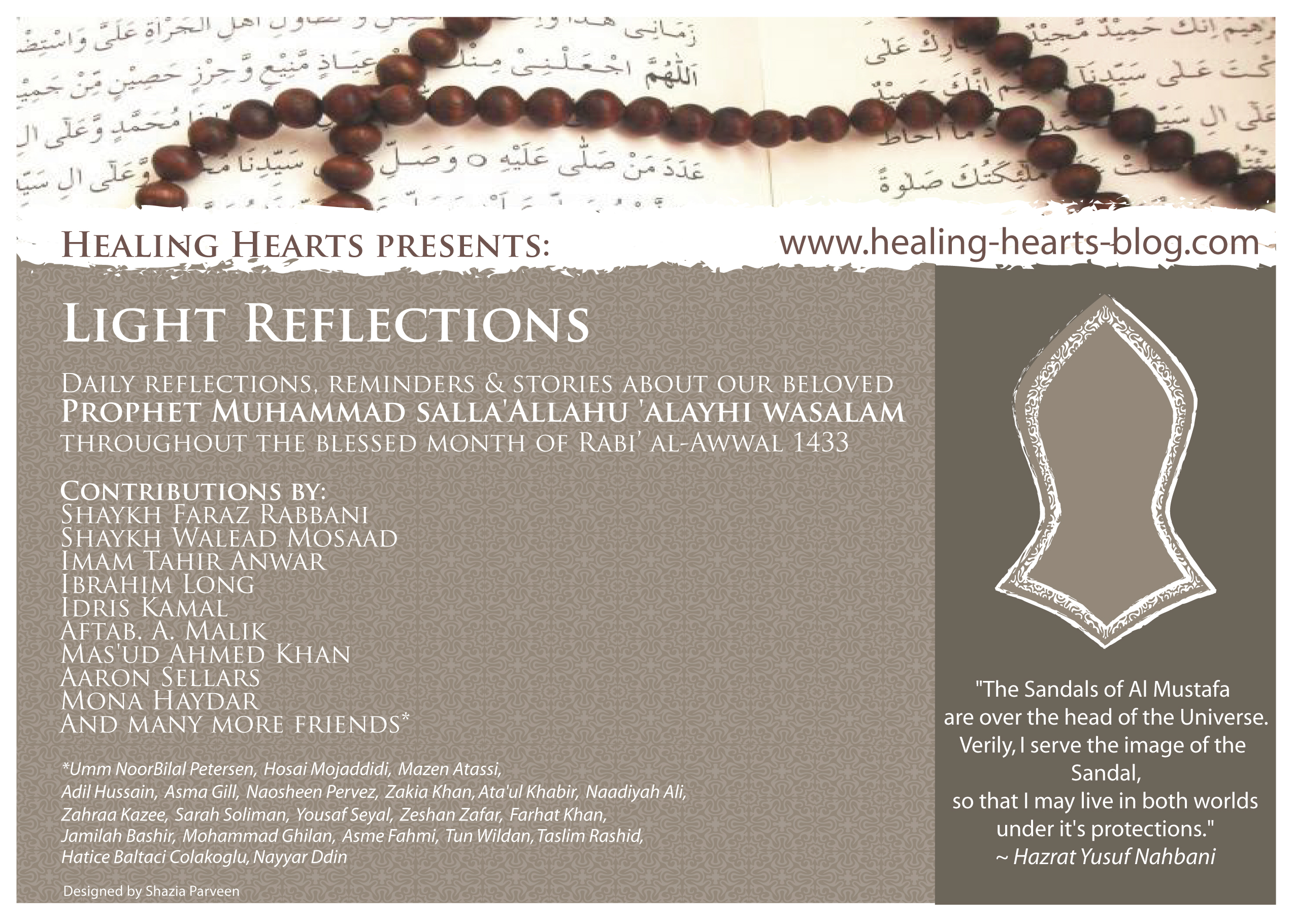 Daily reflections, reminders and stories about our beloved Prophet Muhammad sallaAllahu ‘alayhi wasalam throughout the blessed month of Rabi’ al-Awwal 1433 on Healing Hearts.
Contributions by: Shaykh Faraz Rabbani, Shaykh Walead Mosaad, Imam Tahir Anwar, Ibrahim Long, Idris Kamal, Aftab. A. Malik, Aaron Sellars, Mona Haydar, Umm NoorBilal Petersen, Hosai Mojaddidi, Mas’ud Ahmed Khan, Mazen Atassi, Adil Hussain, Asma Gill, Naosheen Pervez, Zakia Khan, Ata’ul Khabir, Naadiyah Ali, Zahraa Kazee, Sarah Soliman, Yousaf Seyal, Zeshan Zafar, Farhat Khan, Jamilah Bashir, Mohammad Ghilan, Asme Fahmi, Tun Wildan, Taslim Rashid, Hatice Baltaci Colakoglu, Nayyar Ddin
May we all benefit from this special series, and may it be a source and means of increasing our understanding, love and connection to the beloved Prophet sallaAllahu ‘alayhi wasalam.
A big thank you to all the contributors! May Allah the Most Generous reward you all in abundance. (Please keep all the contributors and their families in your blessed prayers.)
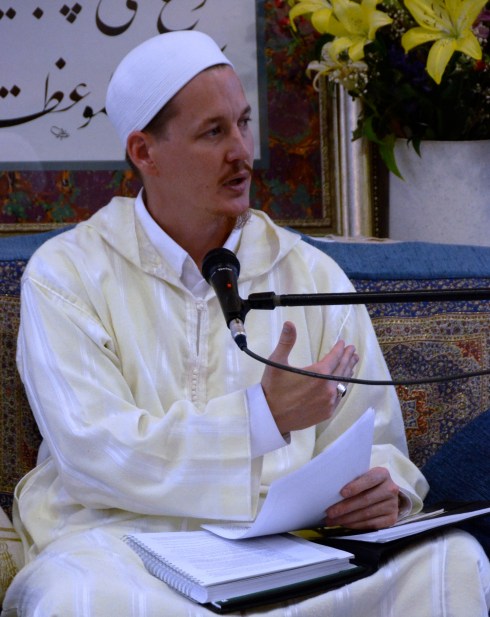 Anyone who is in a state of heedlessness, and reads the Ihya, it will take them into a state of presence.
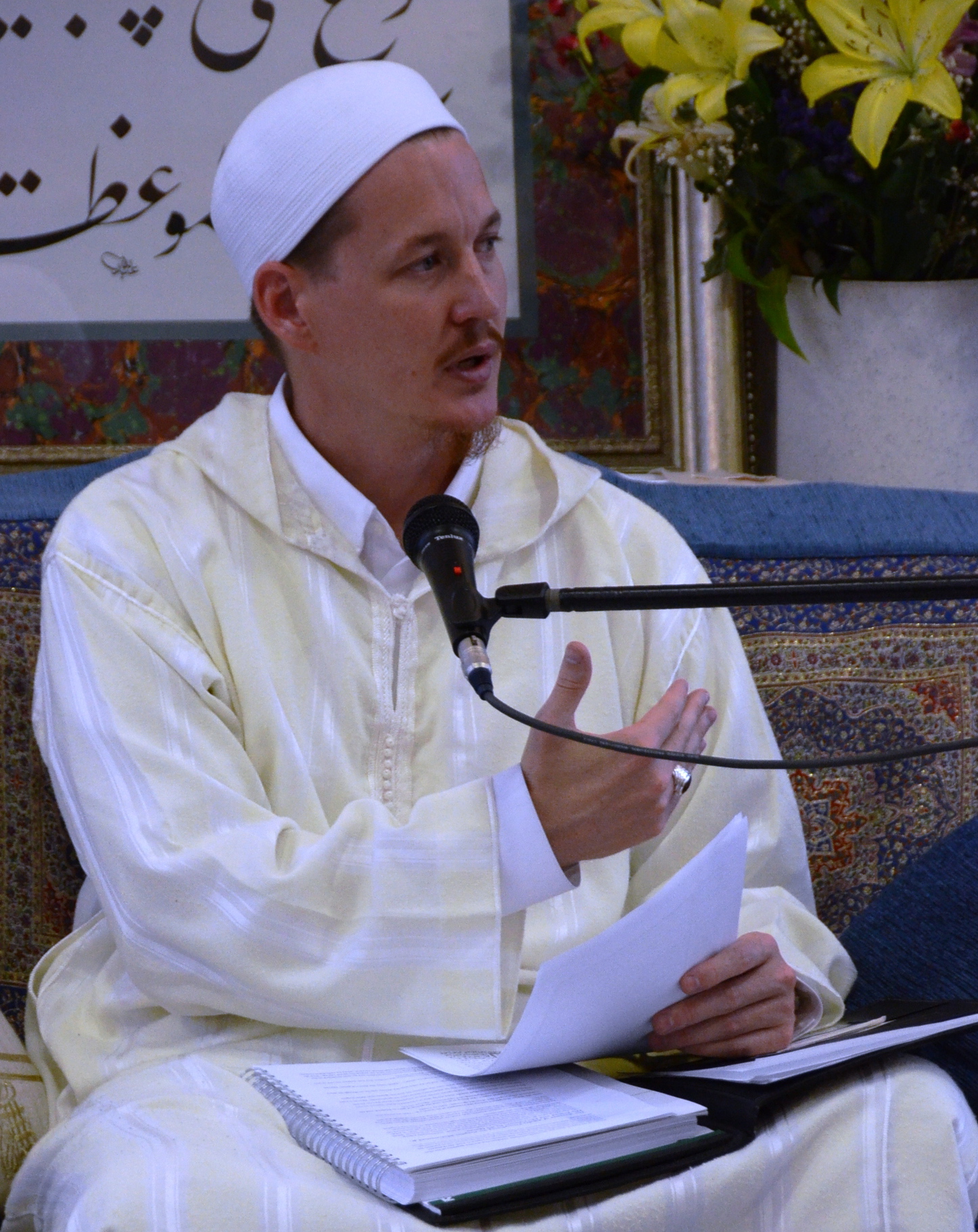
- Hearts have a colour. Everything we do colours the heart in a certain way. Something about the Ihya is that it grabs you and takes you from heedlessness to presence.
- Ostentation- a type of ostentation is when you get happy when someone hears/find out you have done good.
- Reading the Ihya is the process of healing.
- Adab is the essence of our deen (religion).
- Indeed the Qur’an is the banquet of Allah so benefit from it, and what He gives you.
- If you let the world overtake you, it will let you. It will eat you up and you will always be constricted.
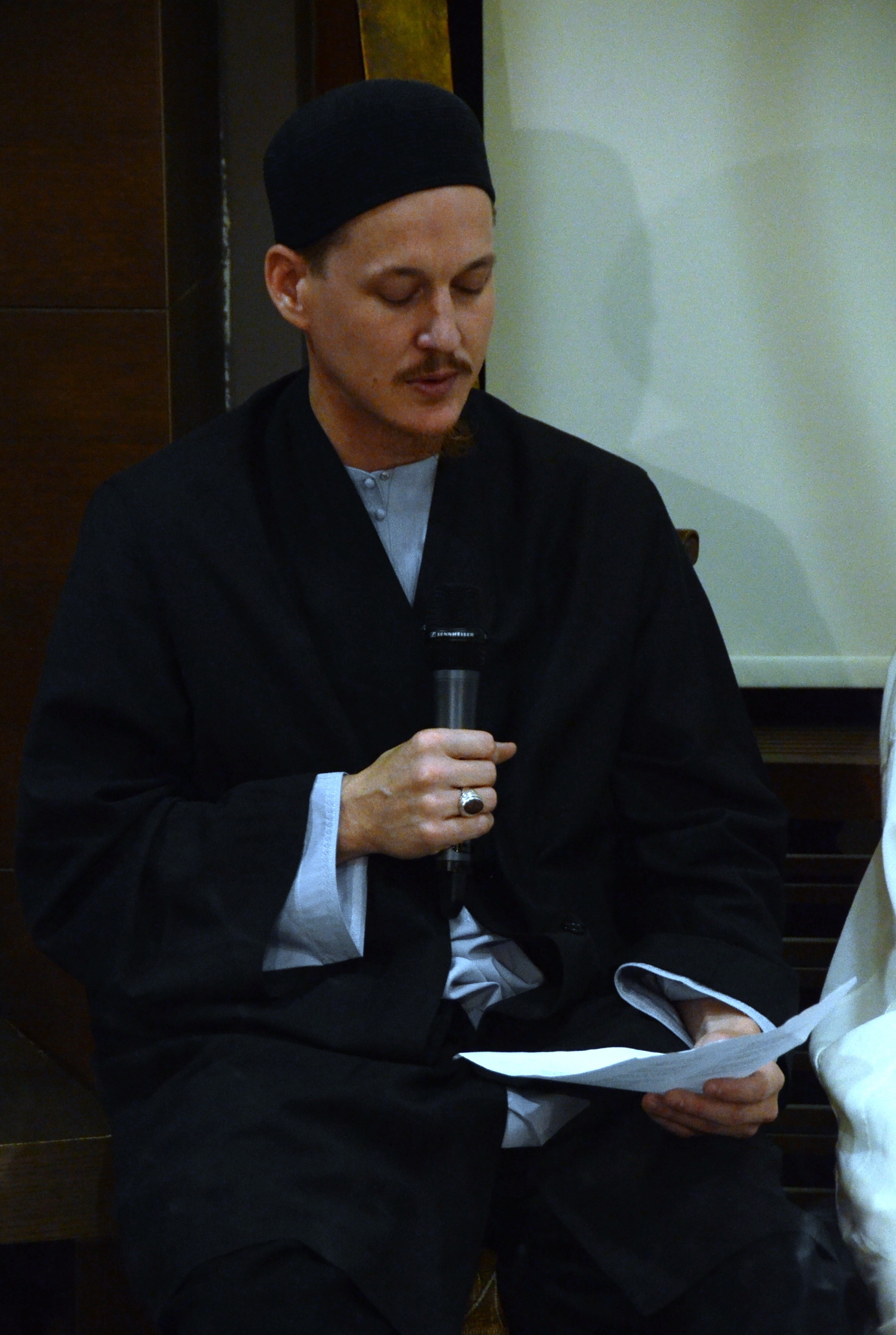
- Contentment is a treasure that will never perish, the Prophet sallaAllahu alayhi wasalam said.
- The Prophet sallaAllahu ‘alayhi wasalam is the way to ultimately judge everything by.
- The story of the Prophet sallaAllahu ‘alayhi wasalam’s life should be directly related to our connection to the Prophet sallaAllahu ‘alayhi wasalam. You can only determine the scholar if they love the Prophet sallaAllahu ‘alayhi wasalam.
- You should never increase in knowledge until you also increase in humility. The more in knowledge you increase, the more humility you should have.
- Reward and punishment relate to the inner realities of human beings.
- We need to bring back the sunnah of smiling!
- Allah created everything in existence. He embellished its form and order. He is the One who measured it out and cautioned it in the best way. Nothing is in existence, except It’s wisdom.
- Knowing how to apply ones knowledge is something, and knowing how to place something in its position is another thing.
- The greatest crisis of our time is the crisis of adab.
- Adab is related to wisdom and putting things in their right place.
- The inward relates to the outward; and the outward relates to the inward.
- The outward etiquette’s are proprieties. The way of carrying them outwardly is indicative of what is in one’s heart.
- Nothing is done outwardly for except it stems from the heart, and nothing comes to the heart unless it’s from a thought.
- Righteous people don’t even backbite people in their thoughts!
- All behaviour begins with a thought; they have a natural inclination. Then you decide one way or the other on what you are going to do.
- We are not taken into account for our thoughts or inclinations. We have to struggle- learning to control ourselves.
- Our deeds that we do is a trait of our character.
- The Prophet sallaAllahu ‘alayhi wasalam is the gifted mercy from Allah to us. The Prophet sallaAllahu ‘alayhi wasalam brought guidance to us.
- Learning is a process; it’s from the cradle to the grave!
- The hidden secrets of the heart- these are the planting places for seeds. It is the light of these innermost secrets of the heart; these are what shine outwardly.
- Whomsoever’ heart is not in a state of humility, their outward state will not be in a state of humility.
- The heart spreads light if there is light in it.
- Your heart is constantly changing. It’s important to know the state of the heart.
- The spiritual path is not linear. You will get what you need in the moment you need it but it’s not the way you expected. Everything that comes to you is in reality for your benefit. We accept the Qadr (Decree); not only accepting, but also knowing the lessons Allah has/is teaching us through that. We might learn through by being hurt, or through tribulations.
- No one served like the Prophet sallaAllahu ‘alayhi wasalam did. He was in the service of people and His Lord. Anyone who does not serve, will not progress spiritually.
- Don’t cut off ties with any of your family; doing so cuts off the Mercy from Allah.
- One is in absolute need of his Lord and there is nowhere else to go!
- Knowledge gives birth to other knowledge! Anytime you learn something, you should write it down. Review and revisit notes. You take notes on the basis of teaching others.
- If we don’t learn from lessons from people, we become lessons to other people.
- There has to be a balance in everything, except dhikr of Allah which needs to be constant/often.
- Be patient with everything that afflicts you.
- If you are the easiest person to please, and the hardest person to get angry then everyone will love you!
- Don’t be content with what you have achieved, keep going. Shaitaan and Nafs will tell you to stop and hold you down, but don’t you listen to them!
- If we are not thankful to Allah for small amounts, then how are we ever going to be thankful for great amounts? Gratitude is the key to tawfiq (success).
- Make big intentions. Allah opens 70 doors of tawfiq for the one who opens up him the door of righteous intention.
~ Shaykh Yahya Rhodus– The Life Conduct the Prophet sallaAllahu alayhi wasalam, Rihla 2011, Bursa, Turkey (Paraphrased)
More gems to follow inshaAllah ta’Ala……
(Photos’ courtesy- Rihla Student Please keep them in your prayers. Please do not re-use or save the photo without permission. )
Gems from Rihla 2011- Shaykh Hamza Yusuf (Part 2)
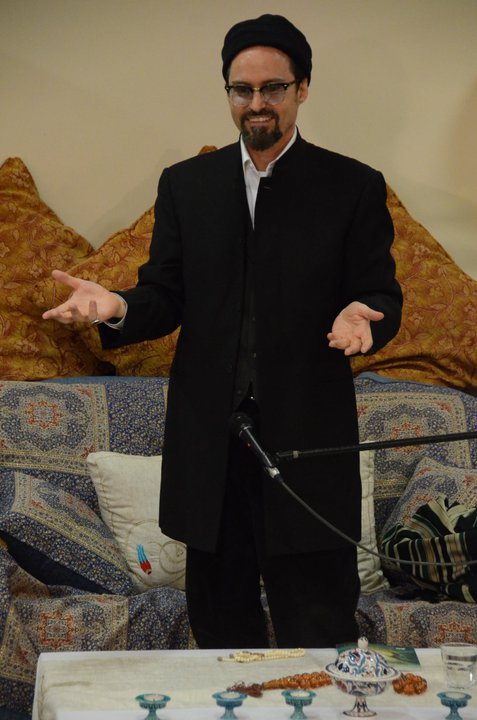
- Imam al-Ghazali is a giant; he is a mountain. And the more you learn about him, the bigger the mountain becomes.
- The Iyha was Imam al-Ghazali’s magnum opus. He wrote it with the intention of giving the Ummah the book that besides the Qur’an will be enough for the educated Muslims. Some argue that the Ihya is all you need as your guide back to Allah.
- The Ihya has immense impact. First thing tells us that the Ihya is in 4 parts. In each section/part Imam al-Ghazali put 10 books. There are 40 books in the Ihya. 40 is a special number.
- The Qur’an is central to Imam al-Ghazali’s teaching.
- If God can make a house holy, you don’t think He can make a heart holy? If He can sanctify stones, He can sanctify a human heart.
- If you’re knocking at the door, the knocking is itself the opening of the door; if you are journeying, your start is your beginning, don’t worry if you don’t get there. Stop wasting time. Death is waiting for you. This was the key message of Imam al-Ghazali
- Only thing that reduces anxiety is by certainty (Yaqeen), and knowing that everything that happens is only because of Allah, and you’re in good hands.
- Wudu is ibadah. It’s independent worship. You can do wudu just as a form of worship. If you are not doing any practices to prepare for prayer, you will probably not feel anything in prayer. Sidi Ahmed Zarruq said “The degree of your presence in prayer is dependent on your wudu”
- Wudu comes from Wada’a which means to make bright. The wudu is how the Prophet sallaAllahu ‘alayhi wasalam recognises his Ummah on the day of judgement, i.e by the light of their limbs.
- Don’t let shaitaan take the light away from your prayer.
- You have to have time between you and your Lord.
- The greatness of the creation of the mosquito is no less than the greatness of the creation of the elephant. Everything that happens is a cause for marvel.
- The whole world is a metaphor; we are all travellers in this world.
- The world can reject you, but Allah will never reject us. His door is always open.
- Allah created a world of expansion and contraction. The heart contracts and expands. Natural state of human is that he is in-between contraction and expansion.
- Allah creates death and life to try us to see which of us is best in virtue and action.
- If you are in blessing, you have to be very grateful.
- The easiest thing in this world is not very beneficial. The hardest thing is very beneficial. The struggle is what makes us stronger and gets us closer to Allah.
- In the lifting up of our feet, even the act of walking is indicative of our fitra desire to yearn for a return to al-Jannah.
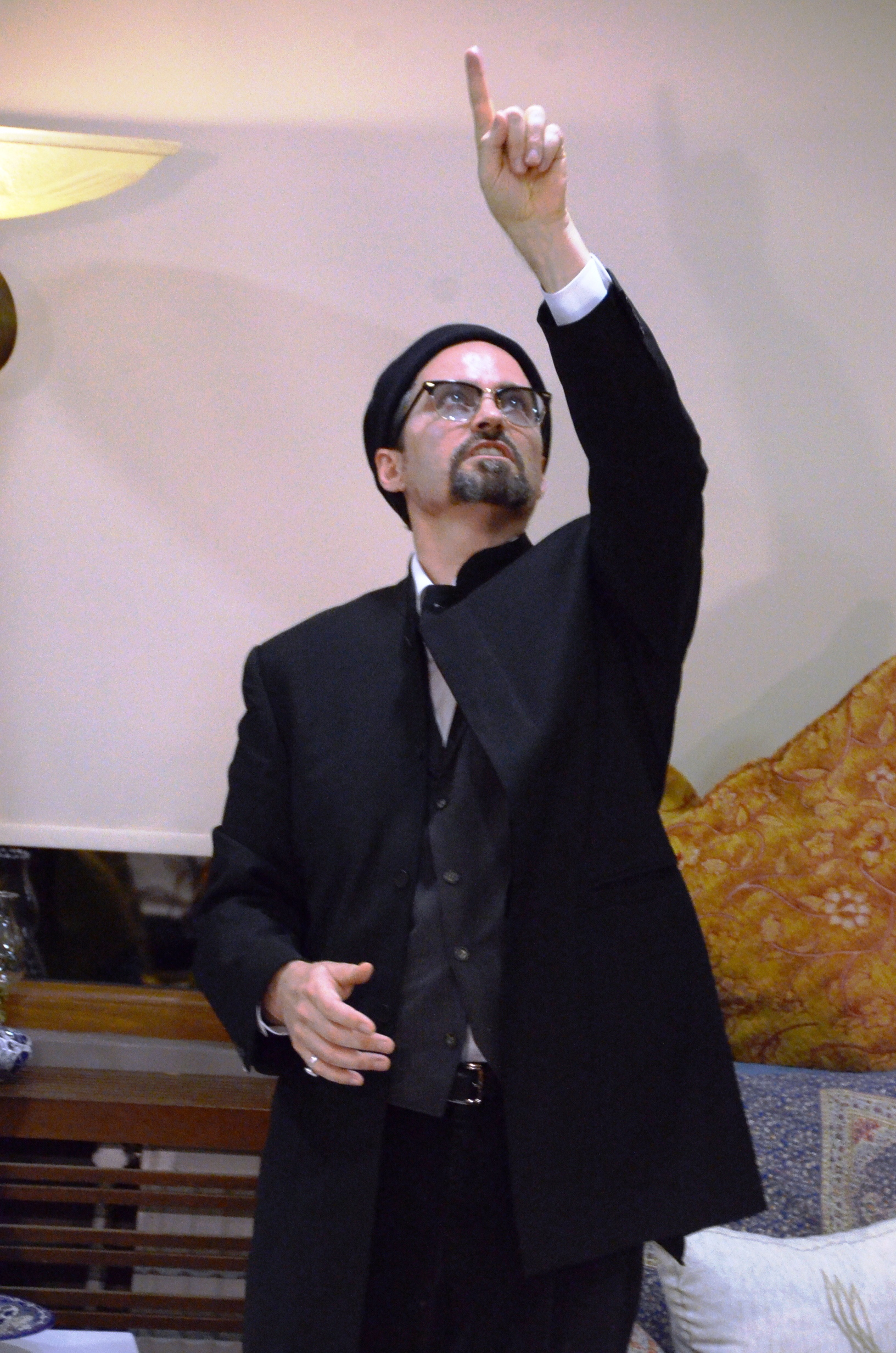
- The Van Allen belt is formed by Earth’s rotation and serves as a protection barrier from radiation. This is the secret behind the power and protection of making tawba and our turning to towards Allah.
- The recording Angel on the left doesn’t record our sins until the end of the day. So hasten to make tawba.
- Our aspirations should always be in the celestial. That’s why almost all of the early scholars of Islam were astronomers.
- Every civilization in power has been obsessed with astronomy and law. Astronomy equals law of the heavens; Law equals law of the land.
- If the stars ever go out in the night sky, how will men come to know God?
- Just as the sun rises bit by bit, it’s the sunnah of God for openings from Him to also come bit by bit. So, be patient
Allah created the stars:
1. As a way to ornament the sky with the lamps- stars so we would marvel at them.
2. To strike down the shaitan.
3. Signs that we are guided by.
4 Levels of patience:
1. Patience with ibada (worship).
2. Patience with avoiding sins.
3. Patience with tribulations and we show this by being content with the decree of Allah.
4. Patience with blessings, we show this by thanking Allah for all the blessings He has given us.
- When things get really bad, know that things will get better. The Sahaba (companions) of the Prophet sallaAllahu ‘alayhi wasalam used to say that when they were in trepidation, they knew bad/hard things will be coming their way, and when bad things happened, they knew that good things will be coming their way.
- If someone commits to the practice of surrendering and sabr (patience), over time the tribulations become easy and they no longer feel the tribulation. You are in paradise whilst in duniya then!
- ‘We will test you until we see who is patient’- to see what you are made out of. The struggle and patience go together. The best attitude to have is patience.
- Patience takes time and effort. Over time you can acquire this natural state.
Don’t attach to dunya because:
1. It’ not permanent
2. It is the tests you will go through due to it
- ‘With hardship comes ease’ The ease will overwhelm the hardship!
- In tribulations, things come slowly. The night is peeled away. Just as the night is peeled away slowly, tribulations move away slowly.
- The opening is there, but will only come when the time is right!
- The clouds of goodness contain rain; when the time comes, it will pour. Allah sends down rain to dead lands; He does it at the appropriate time. When the appropriate time for openings come, it will come. He does things in His time, not our time. This is part of being content with the Qadr and what happen has been apportioned for you.
- A person is not a Sufi until the angel does not record a sin for 20 years!!
- A person on a path will change 40 times in a day where as those who do not have a path stay in the same state for 40 years!
- Your spiritual life is not curvier linear; it should be constantly moving up!
- A life is made up of building blocks and how you move through the knowledge block.
- Every believer is a wali.
- Shariah = outward path to Allah, Tariqah= inward path to Allah and only joining the both together will give you Haqiqa- reality.
- Seeing the Creator in all of creation and seeing the Provider in all provision is Tawheed in a nutshell.
- When doors of guidance open for you, hasten up. Don’t try to get to the end before the beginning.
- ‘Practice makes perfect…’ no it doesn’t, it makes permanent. If you practice wrong, it doesn’t make perfect. You need a Teacher.
- Don’t follow books; follow the people who know the books.
- Often times people are deficient in one area, but are made up for it in another area. Historically, Muslims recognised this.
- One of the great mysteries of the Qur’an is that no matter how often you read it, you always find something new in it.
- So many verses in the Qur’an relate to being patient. Being patient with people in Iman/faith. Some are naturally born more tolerant, but you can change that.
- Patience is a sign of sincerity and its from Taqwa you show patience.
- Even the Prophet sallaAllahu alayhi wasalm was commanded to be patient!
- Allah loves the patient; part of the reason the tribulation comes is to draw the quality of patience out of them- He loves this quality. Allah is with the patient one.
- When tribulations hit you, patience (sabr) is actually when you are accepting something. This also relates to having a good opinion of Allah. When you have a good opinion of Allah, the tribulation you know happen for a reason, although it might not seem so at the time.
- The one who submits their entire being. This means that the future is not a concern for them, and the past is not a worry for them. They are living in the present. There are people of good and those who do good; they are not in fear and nor do they grieve.
- Children are very much in the moment, they do not worry or care about their past or future. The Arifs’ (Gnostic) heart is like the child. Childrens hearts are in submission. They are in Tawhid.
- Trusting the past is over, and doing Tawba that its over. If you truly made tawba, you don’t remember your sin as it obliterates the past. Tawba is like editing a video. You go and edit the parts of the video you do not like so on the day of Judgement, you can see the film without any blunders. Just say Astagfirullah, the angels will cut the bad thing!
- Hold onto Allah! He is your Lord, He is the One who takes care of your affairs.
- Some people focus on reliance on Allah, others only focus on means; but a balance of both is all that will save the ship of humanity.
- If you make all of your concerns of the akhira (afterlife), Allah will take care of everything for you.
- The benefits of your Lord are many; all the benefits of your Lord are for your nourishment. It has a beautiful fragrance- seek it out.
- The blessings of Allah are countless.
- Sometimes there is a fail that comes that brings you to life; there are great waves/ocean that come to you. Creation is all in the hands of Allah; some are being elevated, some being debased; some are being difficult or tested in blessing.
- Media is one of the tribulations of our life, they make things worse!
- Single most difficult limb is the tongue. Its one of the great wonders of Allah. You have to discipline the tongue. The tongue is a great tribulation.
- The world is not cursed. The world is also the cosmos. When we talk about the blameworthy aspects, we mean the duniya. This mountain (Uludag) is not cursed, it’s an incredible testimony of Allah.
- You should worship Allah because He is worthy of worship!
- Allah is Wahid- al-Qahr. Everything in the heaven and earth are acknowledging this at some level. He is calling us to reflect on this. The events that happen in our lives are purposeful; there is always a reason behind it.
- The best sleep is immediately after Isha and the Prophet sallaAllahu ‘alayhi wasalam said not to engage in too much entertainment at night.
- Nawafil night prayers protect the body from diseases and wrong actions. But you won’t be able to get up if you sin a lot.
- Contentment with the decree of Allah is appropriate- this should be your reliance. The Contentment with Allah’s decree is a very high Maqam. Rabia al-Adawiya was asked how do you know if someone is content with Allah’s decree. She replied by saying ‘ When you feel the same joy in periods of tribulation as you do during periods of blessing’
~ Shaykh Hamza Yusuf – Jewels and Pearls of the Qur’an lesson, Rihla 2011, Bursa, Turkey (Paraphrased)
More gems to follow inshaAllah ta’Ala……
(Photos courtesy- Rihla Student Please keep them in your prayers. Please do not re-use or save the photo without permission. )
Since it’s Ramadan, I thought I’d share some notes relating to the benefits of fasting, eating less etc, from “Breaking the Two Desires” class we had with Shaykh Abdal Hakim Murad on the Rihla this year.

- The way of the fitra is to keep things in balance.
- The 2 main desires are: gluttony (obsession with food) and lust (sexual desires)
- The dangerous of sins is gluttony, for by means of this desire, Allah expelled Adam and Hawa from the abode of permanence to the abode of humiliation and neediness. In so far they had been forbidden the tree, but their desires overcame them and they ate from the tree. Desire for food is the primal desire which kick starts the whole process of what expelled Adam out of al-Jaanah in the first place.
- The belly is the fountainhead of desire and the seabed of sickness and defect. It is followed by the desire by sexual relations. The desire for food and physical relations is followed by strong desire for status and wealth, as these provide more opportunities for sexual enjoyment and gluttony. Once we have stuffed ourselves with food, we fill ourselves with other desires. By acquiring wealth and prestige, the vice of ostentation, boasting, pride and arrogance then follows. This then leads to hatred, rancor, envy and other things; which then leads the person who has these vices into oppression and other ugly acts. All of this comes from not paying attention to the stomach and what goes in it.
- The halal we eat, the adab and attitude towards food is very important. We need to get our attitude right towards food and then the other things will all fall into place.
- Get two things right:
1. Eat what is in front of you and be less fussy
2. Don’t be obsessed by food and desire less
If you get these two things right, you will find the rest of the deen will become a lot easier.
- Imam al-Ghazali talks about the sunnah of food and eating in the Ihya, but its something which we do not want to think about.
- We are not designed biologically to eat in a 5 star hotel! We are designed to eat less…
- The holy Prophet salla’Allahu ‘alayhi wasalam shows us the alternative. His way is a way of zuhd, and not being very interested in a whole lot of food.
- Fasting helps, eating not too much helps, and not being inwardly attached to food helps overcome the beast within us.
- We need to be less interested in what is provided, and more grateful for what Allah ahs provided us, i.e being in that maqam of shukr.
- Allah created our bodies in balance, but we have eating disorders and dieting disorders. People over-eat for many reasons, such as anxiety, fear. The disorder in this world is to do with gluttony.
- Allah created enough for us to eat but due to greed, we are destroying the planet by eating too much!
- The holy Prophet sallAllahu alayhi wasalams’ hunger was so great that he would tie stones to his belly. The sacrifices he made when he could have been the lord of the Queresh are unimaginable, and he only made those sacrifices for us. Where as we can be in this hotel and all we do is complain about the buffet!
- The lives of the awliya have always been focused on the principle of eating less. It’s the quality of the awliya.
- Through fasting, we are constantly knocking on the door of paradise.
Imam al-Ghazali talks about the benefits of fasting/eating less and making the stomach hurt (Shaykh Abdal Hakim Murad went through these benefits in detail but I have summarised only a few below)
1. Purification of the heart and helping one’s perception to be more penetrating. If you don’t eat so much, you will be more perceptive; your basira (insight) will go much further. Ramadan is hard work, but towards the end of it, we do feel that things in deen are coming to us with more ease. We can feel we are detached from duniya and the hunger you feel, you get used to it so you don’t even notice it much or think about it. You are no longer distracted by hunger, and are in a state of greater purity.
2. Brokenness, humbleness and ending of pride and exuberance. The pride we get into after eating good food, if we are hungry our pride is broken. We experience this in Ramadan. In Ramadan if you have been fasting for 10-12 hours, it is harder to be proud, we are broken a little bit. Pride is deadly of the deadly sins and hunger helps suppress that.
3. Through hunger we do not forget Allah’s trials and tribulations. The one who is always full ignores the one who is hungry and ignores the reality of hunger. However, when we fast, we empathise with those who are hungry.
4. Breaks everyone of the desire for sins, and helps control the nafs- the beast that is within us.
5. Helps us worship more.
6. No need to earn so much if we eat less. If you eat less, you can spend less, and that extra money you are saving can go towards sadaqa.
- Imam al-Ghazali talks about rejecting the imbalance, he doesn’t say abandon food completely but instead watch what we eat.
- Ramadan is all about sabr- patience.
- To be in a maqam of aboodiya (servanthood) shows us that we are always in need of Allah.
- Allah is active in every moment. He is constantly creating and re-creating. Everything is the unique consequence of Him.
- Allah didn’t just wind the clock at the beginning of the time and sat back to see everything unwind; our needs which we are not even aware of, He fulfills them.
- The benefits of physical discomfort like eating less is that we are in a constant state of absolute need, absolute dependence on Allah. He doesn’t need us, but we need Him for everything!
- When we start to recognise everything is from Allah and He is al-Wakil, we will find tranquillity. People who have always been in hardship will always be in a state of calmness and ease, then those who always have things their way.
- Sometimes to be woken up, we need to be slapped!
~ Shaykh Abdul Hakim Murad, ‘Breaking the Two Desires’ class, Rihla 2011, Bursa, Turkey (Paraphrased)
More gems to follow inshaAllah ta’Ala……
(Photos courtesy- Ibrahim Varachia. Please keep him in your prayers. Please do not re-use or save the photo without permission. )
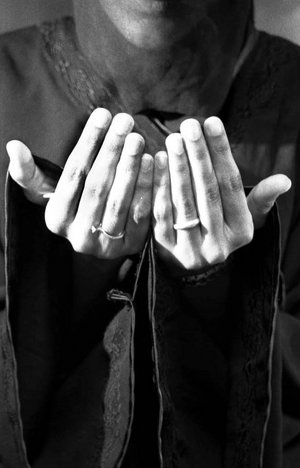 A beautiful prophetic supplication (dua):
Transliteration: Yā Hayyu ya Qayyūmu bi rahmatika astaghīthu, aslih lī sha’nī kullahū wa lā takilnī ilā nafsī tarfati ‘aynin.
Translation: O You the Everlasting and All-Sustainer I fervently call upon Your mercy so that You may set right all my affairs and may not leave me to myself for the blink of an eye
( Al-Mustadrak)
The Prophet Muhammad (peace be upon him) said: “The believer’s shade on the Day of Resurrection will be his charity.” [Tirmidhi]
“The Cambridge New Mosque Project needs to raise funds in order to move forward with the building the UK’s first eco-friendly and the first ever purpose-built mosque in this historic city. We need your help and support in our endeavor.”
Support Cambridge Mosque’s live Ramadan Appeal: One Night. One Million. 30th August 2010.
For those who are not aware, Shaykh Abdal Hakim Murad has been doing a daily Ramadan Travelogue. Please read, benefit and remember to donate towards the Cambridge Mosque project. No better month to give charity than in Ramadan!!
“Whoever builds a mosque, desiring thereby Allāh’s pleasure, Allāh builds for him the like of it in paradise” Hadith
Please help and spread the word!
Allahumma salli ‘ala Muhammadini n’nabiyyi l-ummiyyi wa ‘ala alihi wa salam taslima(n)
O Allah! Send Your mercy on the Unlettered Prophet Muhammad and on his family and shower him with peace.
Whoever recites this 80 times on Friday after Asr prayer before moving from his place, 80 years of his sins will be forgiven and 80 years of worship will be allocated to him. (Jami al-saghir, Al-Qawl al-badi, taken from “Reflections of Pearls by Imam Uddin & Abdur-Rahman Ibn Yusuf”)
Abu Hurayrah narrates that the Prophet salla’Allahu ‘alayhi wasalam said:
“When Ramadan begins the doors of paradise are opened, the doors of hell closed and the devils tied up.” (Bukhaari & Muslim)
” The tree does not withdraw its shade from the woodcutter. So, love even those who hurt. They’ll realise your worth someday.”
A beautiful friend sent me the above quote which really made me think and reflect. To still love those who hurt us takes a lot and very often its easier said than done. It reminds me of our beloved Prophet salla’Allahu ‘alayhi wasalam and how some of his loved ones really hurt him and chose to reject him as a Messenger of Allah. The hurt and grieve they gave him salla’Allahu ‘alayhi wasalam, didn’t deter him from his mission. Just like the tree who does not withdraw its shade from the woodcutter, the Prophet salla’Allahu ‘alayhi wasalam still gave and showed love, compassion, mercy and kindness to all those who hurt, ridiculed and harmed him. These noble qualities which he demonstrated in his conduct, softened the hearts of those who opposed him; they realised his worth and his uniqueness, thus accepted Islam. Those unfortunate souls who did not realise his worth during his lifetime will realise his worth on the day of judgement. Loving those who hurt us is a prophetic characteristic, and may we all aspire to achieve this; whether those who hurt us realise our worth in this life or not, Allah does and that’s all that really matters at the end of the day….
I came across this on YouTube; Shaykh Hamza Yusuf speaks about the last moments of the Prophet salla’Allahu ‘alayhi wasalam’s life. One cannot help but cry whilst listening to this really moving and beautiful speech. May our love and attachment to the prophet salla’Allahu ‘alayhi wasalam increase, and may we be granted his company in al-jaanah. Amin!

 Healing Hearts
Recent Comments