
You are currently browsing the yearly archive for 2011.
In the name of Allah, Most Gracious, Most Merciful. All praise be to Allah, Lord of the worlds, and peace and blessings be upon His Messenger Muhammad, mercy to the worlds.
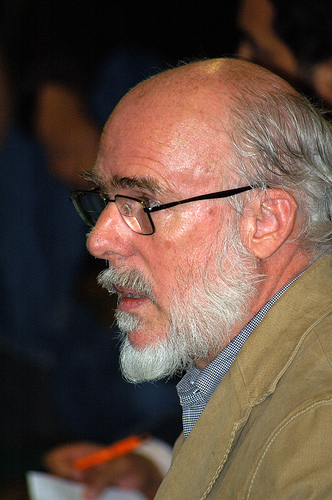 In 2006, Dr Umar visited the UK and delivered a superb lecture on the “Famous Women in Islam” in Birmingham. I was just going through my notesbook today and found some of the notes I made during the lecture, and thought I’d share them here so others can benefit from, and be inspired inshaAllah ta’Ala. (Photo credit: Mas’ud Ahmed Khan)
Dr. Umar Faruq Abd-Allah- Famous Women in Islam- 25th November 2006
* Many greater women were Sufis and they trained men.
* Status of women has changed.
*Many of the stereotypes heard in the west and Muslim world (women’s job is to clean, cook etc) developed in the early modern world.
* The working class women in Egypt, Pakistan, Morocco; who have 1-2 jobs as well as looking after the household needs and children whilst their husbands are in different countries working, are true heroines!
* The prophet SallaAllahu Alayhi Wasalam didn’t hurt women. Women were essential to his life. This started with Khadija RadiAllahu Anhu, she gave the prophet SallaAllahu Alayhi Wasalam Strength to overcome the initial period of revelation.
* Aisha RadiAllahu Anhu was the defender of Islam.
*Islam began in the hands of a women, i.e Sayyida Khadija was the first women to take Shahada.
*The prophet SallaAllahu Alayhi Wasalam gave special timings for teaching women. Even when he SallaAllahu Alayhi Wasalam was ill, near death and didn’t have much strength, Bilal RadiAllahu Anhu held him up so he could counsel women.
* The prophet SallaAllahu Alayhi Wasalam accepted womens influence (his aunts and wives). For example; Umm Salamah advised the Prophet SallaAllahu Alayhi Wasalam to go out and shave his head and slaughter sheep so the companions would follow his example. (*look up story in seerah)
* One maxim of Islamic Law is everything is permissible until proven impermissible and it’s not an easy task to *prove* something.
*Men and women completely equal in Islamic law until proven they are not.
* The army never went out to battle without women. Women were always equal in number.
*Women tend to be more religiously devoted.
* Throughout history, we have come to know about men who had fabricated hadiths, but not one single women fabricated a hadith and there have been thousands of women muhaddiths!
Exceptional women in Islam:
Zubaida Bint Jafir
*Wealthiest and powerful women in her time.
*Generous; gave to the poor, Christians, poets etc
* Her palace sounded like a beehive. She had thousands of maid servants who had hifz the Quran. They would complete the Quran at least 10 times a day.
* Eloquent master of Arabic language, known for her intelligence.
* The people of her time said that she was the women who brought earth to life.
*If you want to affect people and change them, tell stories! Stories affect people greatly, just like when we read stories in the Quran.
* 19/20 century is a very difficult time for us. Tipu Sultan was the last magnificent ruler, everything declined and changed after that.
*Also, never feel disempowered when you are unable to do things or don’t have the means to acquire
May Allah bless and preserve Dr. Umar, Amin!
Please be aware that these are my notes, they are not comprehensive at all but I pray what I do share is of some benefit to the readers. Any mistakes, errors or misinterpretations of words are from me alone, so please do forgive and overlook my shortcomings! You are welcome to share these notes but *please* do not just copy and paste anything without referencing where you got them from as I do not want my notes to be taken out of context or misinterpreted.
Salat al-Haja (Prayer of Need)
Abullah ibn Abi Awfa (Allah be pleased with him) relates that the Messenger of Allah (Allah bless him and give him peace) said, “Whoever has a need with Allah, or with any human being, then let them perform ritual ablutions well and then pray two rakats. After that, let them praise Allah and send blessings on the Prophet (Allah bless him and give him peace). After this, let them say:
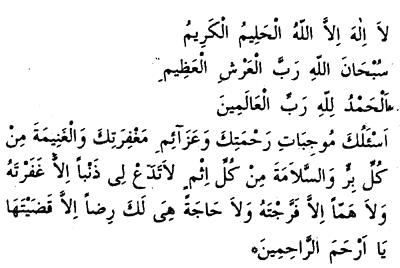
“There there no god but Allah the Clement and Wise. There is no god but Allah the High and Mighty. Glory be to Allah, Lord of the Tremendous Throne. All praise is to Allah, Lord of the worlds. I ask you (O Allah) everything that leads to your mercy, and your tremendous forgiveness, enrichment in all good, and freedom from all sin. Do not leave a sin of mine (O Allah), except that you forgive it, nor any concern except that you create for it an opening, nor any need in which there is your good pleasure except that you fulfill it, O Most Merciful!”
The prayer of need is very simple: It is essentially to raise one’s need to Allah Most High, by performing ritual ablution (wudu), praying 2 rakats (or four), and then making whole-hearted dua to Allah. If one uses the above mentioned Prophetic supplication, or other similar supplications transmitted from the Beloved Messenger of Allah (Allah bless him and give him peace), it is best. [Ibrahim al-Halabi, Sharh Munyat al-Musalli; al-Fatawa al-Hindiyya; Ibn Abidin, Radd al-Muhtar]
The inward manners of supplication is exhibiting our neediness and absolute slavehood to Allah, consigning one’s matters to Allah, and knowing that the only one who gives or benefits is Allah Most High. With this, one should be certain that Allah Most High answers our duas, but in the way He knows is best for us.
When circumstances do not permit us to pray 2 rakats, one should still turn to Allah in supplication, raising one’s needs to Him, for He answers our supplications and loves being asked.
And Allah alone gives success.
Wassalam,
Faraz Rabbani
Taken from SunniPath: http://qa.sunnipath.com/issue_view.asp?id=1117
A young man was getting ready to graduate college. For many months he had admired a beautiful sports car in a dealer’s showroom, and knowing his father could well afford it, he told him that was all he wanted.
As Graduation Day approached, the young man awaited signs that his father had purchased the car. Finally, on the morning of his graduation his father called him into his private study. His father told him how proud he was to have such a fine son, and told him how much he loved him. He handed his son a beautiful wrapped gift box. Curious, but somewhat disappointed the young man opened the box and found a lovely, leather-bound Bible. Angrily, he raised his voice at his father and said, “With all your money you give me a Bible?” and stormed out of the house, leaving the holy
book.
Many years passed and the young man was very successful in business. He had a beautiful home and wonderful family, but realized his father was very old, and thought perhaps he should go to him. He had not seen him since that graduation day. Before he could make arrangements, he received a telegram telling him his father had passed away, and willed all of his possessions to his son. He needed to come home immediately and take care of things. When he arrived at his father’s house, sudden sadness and regret filled his heart.
He began to search his father’s important papers and saw the still new Bible, just as he had left it years ago. With tears, he opened the Bible and began to turn the pages. As he read those words, a car key dropped from an envelope taped behind the Bible. It had a tag with the dealer’s name, the same dealer who had the sports car he had desired. On the tag was the date of his graduation, and the words…PAID IN FULL.
How many times do we miss God’s blessings because they are not packaged as we expected?
Source: Unknown

Words have the power to either make or break us so we should always mean what we say and don’t say what we don’t mean. The trouble is when we have people who think that just because they mean what they say and keep their promises, they think other people are just like that and mean what they say and will keep their promises.
The deeper the wound, the longer it takes to heal. Time is a great healer but Allah is the Greatest Healer. What doesn’t kill us, always makes us stronger, we just have to continue on in our journeys and know that nothing happens without a reason and for some greater wisdom which we may or may never understand.
 Hearts that have been shattered but rebuilt with Allah will always be stronger inshaAllah. The love and mercy Allah provides for His servants, no one else can; the trust and dignity Allah provides, no one else can; the hope and courage Allah gives, no one else can. People will always let us down, make promises they cannot keep, utter words which they do not mean but Allah is Al-Wadud, the All Loving, His love is pure and He never breaks His promises. There really is no greater comfort in life other than knowing Allah is aware of how we feel. He is the All-Aware, the Provider, the Healer, the Caretaker of us all.
In the name of Allah, Most Gracious, Most Merciful. All praise be to Allah, Lord of the worlds, and peace and blessings be upon His Messenger Muhammad, mercy to the worlds.
As-salamu’alaykum!
Alhumdulilah, I was able to attend part 2 of the 99 Beautiful Names of Allah subhananhu wa’tala course over the weekend with Shaykh Muhammad al-Yaqoubi (May Allah elevate his rank and protect him). I thought I’d post some of the gems the Shaykh shared during the course. Please be aware that these are my notes, they are not comprehensive at all but I pray what I do share is of some benefit to the readers. Any mistakes, errors or misinterpretations of words are from me alone and not the Shaykh, so please do forgive and overlook my shortcomings! You are welcome to share these notes but *please* do not just copy and paste anything without referencing where you got them from as I do not want my notes to be taken out of context or misinterpreted.
May Allah reward all those at Sacred Knowledge who assisted in organising and facilitating this blessed course. We look forward to Shaykh Muhammad coming back for part 3 of the course very soon inshaAllah!
 Al- Lateef

- The One who is subtle. He is subtle in handling our affairs.
- He is beyond the reach of people’s understanding when it comes to affairs. His decree is very subtle.
- Our job is to surrender to the will of Allah, and when things happen to us, we say Allah knows best.
- In order to get the right result, you need to hand yourself to Allah
- Allah is al-Lateef. The outcome of His lutf will not appear immediately. For example Sayyidina Yusuf alayhi salam was imprisoned for many years. After being released finally, he was made treasurer of the store houses and then went on to become the leader. This story shows us that sometimes we do not see the sweetness of our struggle straight away and it can take years for us to understand why something happened to us; sometimes we may not even see the end fruits until the day of judgement, but it will all be sweet in the end inshaAllah!
- If you have no clue as to why something is happening to you, then you need to surrender to the will of Allah.
- The power of dhikr is beyond imagination!
- Calamities are divine gifts, they are to test our surrender to Allah!
- His power overwhelms every other power! No one can compare to Allah!
- Allah doesn’t let down any believer!
- The miskeen’s in this duniya are the kings in the next!
- People in al-Jannah (paradise) are not arranged in ranks like they are in this world.
- Reciting Ya-Lateef 129 times is the basic dhikr when afflicted with tribulation and hardship. Maintain this dhikr until Allah takes you out of that tribulation.
- Allah is your Beloved! You love Allah and He loves you! Allah will not betray you! Allah gives you better than what you give, just be patient and wait.
- Sometimes we may get hardship for 20 years but never understand why.
- The awliya (friends of Allah, Saints) say that if a believer is punished in this world then it’s out of the love of Allah because He wants to purify you in this world so you do not enter the hell fire.
- Within a blink of an eye, Allah can change peoples states to the opposite!
- Allah suffices us!!
- Be happy with Allah!
- Ask Allah but don’t complain.
- Never doubt the subtle care Allah is providing for you! His love is divine… His love is pure to us!
- Imam Ibn AtaAllah Iskandari mentioned in his hikam that Allah doesn’t allow you to open your hands and call upon Him, but that he WANTS to answer you!
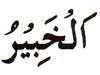 Al- Khabeer
- The One who knows everything. Allah knows the news of everything.
- When Allah wants to take revenge He takes it unexpectedly.
- There is wisdom behind everything. You can give someone with bad adab knowledge, but that person may then pass that knowledge onto someone who has good adab so in effect the one with bad adab is just a means for the person who has good adab.
- Hand all your affairs to Allah and don’t worry about the future- leave the unseen to Allah.
- When you go out and help an old person cross the road, you know that when you are old, Allah WILL send someone to help you too!
- If you are upset, everyone around you is upset. If you are happy, everyone around you is happy, so be happy!
 Al- Haleem

- Al-Haleem is the One who does not punish the people who do not obey Him straight away (in this world).
- Hilm is not to rush to get angry. The prophet sallaAllahu ‘alayhi wasalam was al-Hilm.
- The dua of the oppressed is answered, but sometimes, the dua of the oppressed is not answered because the one who has been oppressed has gone and bad mouthed the oppressor, so by doing that there remains no difference between them both- they are now equal. The wrath of Allah is much more than your wrath so do not take revenge when someone has hurt or wronged you. Leave that to Allah!
- If you want Allah to forgive you, forgive others. Treat people how you want Allah to treat you!
 Al- Azeem

- Al-Azeem means the Great. Allah is the Great, His attributes are Great.Everything compared to Him is nothing. This is why He deserves the greatest respect and servitude.
- The best state is the state you are in! This doesn’t mean you don’t struggle, you should.
- If you can do your best in the duniya, then you can do your best for the aakhira.
- If you believe Allah is the Great, then you shouldn’t fear anyone but Allah!
 Al-Ghafoor
- Al-Ghafoor is the Oft-Forgiving.
- Seeking the forgiveness of Allah is the major cause of prosperity
- Impact of great sins affect us, our health, our business etc.
- Remember you are knocking on the door of Allah whose forgiveness is given to all people in all time!
- Never belittle the power of dhikr. Doubt your state and mind and heart but trust in Allah!
 Ash-Shakoor

- Ash-Shakoor is the One who is thanked.
- Allah gives a lot of reward for the smallest things we do.
- Our share in this divine name is to thank Allah.
- People are just means, don’t be veiled by them. See the Real Giver!
- Learning to be thankful to Allah for not always being given what we want is to be truly thankful.
 Al-Hafeez

- Al-Hafeez is the One who Preserves and is taking care in the best way.
- Al- Hafeez is the One who handles the affairs of the one who are created and protects them from all harm.
- Al- Hafeez is the One who knows all stations and ranks.
- You need protection, go to Allah!
- Repetition is the key to memorisation.
- Allah is sufficient for us, He is enough for us!
 Al-Muqeet
- Al- Muqeet is the Provider. Allah is the One who gives everything He creates substance.
- Allah pre-destined the food for everything He created. Allah will not create an extra human being without creating extra food for him.
- Allah is taking care of every human being!
- Ask everything you need from Allah!
 Al-Haseeb

- Al-Haseeb is the One who is Self-Sufficient. He is capable of providing for His servants. He suffices for everyone.
- Al-Haseeb also means the One who does reckoning.
- Our share in this name is to hold ourselves responsible for our actions. We blame ourselves. Take yourself into account for what you have done.
- Sayyidina Umar radiAllahu anhu said that hold yourself accountable before you are held accountable!
- If you do not get what you want from this world then Allah suffices for you. ‘HasbunAllahu wa ni’mal wakil.’ Allah is sufficient for us and He is the Best Guardian. (3:173)
 Al- Jaleel

- Al-Jaleel is the Majestic. The One Whose rank is the highest. The One who we can never reach and no one is similar in His essence and attributes.
- Allah is the One who has all-Majesty. We need to see His signs. His signs are His miracles in what He created.
 Al- Kareem
- Al-Kareem is the Most Generous.
- Allah is the most Generous. If you want Allah to give you, you need to give to people. If you want Allah to be Generous to you then you need to be generous to people. You give, Allah will give you more!
- Imam Ibn AtaAllah al-Iskandari said that never aspire to the generosity of other than Allah!
 Ar-Raqeeb

- Ar-Raqeeb is the One who Observes, the Watchful One.
- Allah watches over all of His servants. He is taking care and is watching. Allah is providing and listening to the calls when the calls are made!
- The least of grains are not absent from His sight! He is watching over everything.
- Our share in this name is to be observers of ourselves.
- If you have lost something, recite surat Duha and you will find it.
 Al- Mujeeb

- Al-Mujeeb is the One who answers and Gives what He wants and more!
- When giving, give what that person is asking for and extra so you do not make him feel like a beggar and also make yourself generous.
- Every dua you say, every time you say Ya Allah, Allah answers it! Allah is al-Mujeeb, He answers you, do you answer Him? Do you answer His call to prayer?
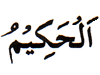 Al- Hakeem

- Al-Hakeem is the Wise One.
- Allah is the Most wise and places everything in its place to balance it out.
- Seeing the wisdom takes a bit of reflection.
- You will never have enough money to distribute amongst people, but you can always have enough good character to distribute amongst everyone.
- People involved in dawah need to have wisdom. Saying to unbelievers that they are going to hell, won’t make them turn towards Allah.
- If you want to succeed in dawah, don’t present Islam by criticising other religions, start with the beauty of Islam
——————————————————————————————
Jaza ‘Llahu anna Sayyidina Muhammadan sallaAllahu alayhi wasalam ma huwa ahluhu
Jaza ‘Llahu anna Sayyidina Muhammadan sallaAllahu alayhi wasalam ma huwa ahluhu
Jaza ‘Llahu anna Sayyidina Muhammadan sallaAllahu alayhi wasalam ma huwa ahluhu
Subhana Rabbika Rabbi l’izzati amma yasifun, wa salamun ala l’mursalin, wal-humdulillahi Rabbi l’alamin.
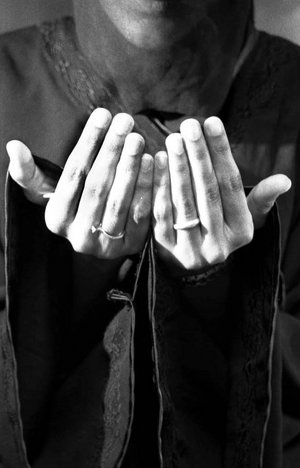 A beautiful prophetic supplication (dua):
Transliteration: Yā Hayyu ya Qayyūmu bi rahmatika astaghīthu, aslih lī sha’nī kullahū wa lā takilnī ilā nafsī tarfati ‘aynin.
Translation: O You the Everlasting and All-Sustainer I fervently call upon Your mercy so that You may set right all my affairs and may not leave me to myself for the blink of an eye
( Al-Mustadrak)
 Actions always speak louder than words, and with one small gesture we can change a person’s life, as the story below tells us…..
One day, when I was a freshman in high school, I saw a kid from my class walking home from school. His name was Kyle. It looked like he was carrying all of his books. I thought to myself, “Why would anyone bring home all his books on a Friday? He must really be a nerd.” I had quite a weekend planned (parties and a football game with my friend the following afternoon), so I shrugged my shoulders and went on.
As I was walking, I saw a bunch of kids running toward him. They ran at him, knocking all his books out of his arms and tripping him so he landed in the dirt. His glasses went flying, and I saw them land in the grass about ten feet from him. He looked up and I saw this terrible sadness in his eyes.
My heart went out to him. So, I jogged over to him, and as he crawled around looking for his glasses, I saw a tear in his eye.
I handed him his glasses and said, “Those guys are jerks. They really should get lives.
He looked at me and said, “Hey, thanks!” There was a big smile on his face. It was one of those smiles that showed real gratitude. I helped him pick up his books, and asked him where he lived. It turned out he lived near me, so I asked him why I had never seen him before. He said he had gone to private school before coming to this school.
I would have never hung out with a private school kid before. We talked all the way home, and I carried his books. He turned out to be a pretty cool kid. I asked him if he wanted to play football on Saturday with me and my friends. He said yes. We hung all weekend and the more I got to know Kyle, the more I liked him. And my friends thought the same of him. Monday morning came, and there was Kyle with the huge stack of books again. I stopped him and said, “Damn boy, you are gonna really build some serious muscles with this pile of books everyday!”. He just laughed and handed me half the books. Over the next four years, Kyle and I became best friends.
When we were seniors, we began to think about college. Kyle decided on Georgetown, and I was going to Duke. I knew that we would always be friends, that the miles would never be a problem. He was going to be a doctor, and I was going for business on a football scholarship. Kyle was valedictorian of our class.
I teased him all the time about being a nerd. He had to prepare a speech for graduation. I was so glad it wasn’t me having to get up there and speak.
Graduation day arrived – I saw Kyle and he looked great. He was one of those guys that really found himself during high school. He filled out and actually looked good in glasses. He had more dates than me and all the girls loved him!
Boy, sometimes I was jealous. Today was one of those days. I could see that he was nervous about his speech. So, I smacked him on the back and said, “Hey, big guy, you’ll be great!”
He looked at me with one of those looks (the really grateful one) and smiled. “Thanks,” he said. As he started his speech, he cleared his throat, and began. “Graduation is a time to thank those who helped you make it through those tough years. Your parents, your teachers, your siblings, maybe a coach… but mostly your friends. I am here to tell all of you that being a friend to someone is the best gift you can give them. I am going to tell you a story.”
I stared at my friend in disbelief as he told the story of the first day we met. He had planned to kill himself over the weekend. He talked of how he had cleaned out his locker so his Mom wouldn’t have to do it later and was carrying his stuff home. He looked hard at me and gave me a little smile. “Thankfully, I was saved. My friend saved me from doing the unspeakable.”
I heard the gasp go through the crowd as this handsome, popular boy told us all about his weakest moment. I saw his Mom and dad looking at me and smiling that same grateful smile. Not until that moment did I realize its depth.
Never underestimate the power of your actions. With one small gesture you can change a person’s life. For better or for worse. God puts us all in each other’s lives to impact one another in some way. Look for God in others.
“Friends are angels who lift us to our feet when our wings have trouble remembering how to fly.”
 The Butterfly

A man found a cocoon of a butterfly. One day a small opening appeared.
He sat and watched the butterfly for several hours as it struggled to force its body through that little hole. Then it seemed to stop making any progress. It appeared as if it had gotten as far as it could, and it could go no further.
So the man decided to help the butterfly. He took a pair of scissors and snipped off the remaining bit of the cocoon. The butterfly then emerged easily. But it had a swollen body and small, shriveled wings. The man continued to watch the butterfly because he expected that, at any moment, the wings would enlarge and expand to be able to support the body, which would contract in time. Neither happened!
In fact, the butterfly spent the rest of its life crawling around with a swollen body and shriveled wings. It never was able to fly.
What the man, in his kindness and haste, did not understand was that the restricting cocoon and the struggle required for the butterfly to get through the tiny opening were God’s way of forcing fluid from the body of the butterfly into its wings so that it would be ready for flight once it achieved its freedom from the cocoon.
Sometimes struggles are exactly what we need in our lives. If God allowed us to go through our lives without any obstacles, it would cripple us. We would not be as strong as what we could have been.
We could never fly!

I came across the following article which I thought was just…….. I really have no words to describe it apart from the fact that it has to be one of the best pieces I have read in a very long time as it really helps to put this life into perspective. Thought I’d share with you all.
By Yasmin Mogahed taken from Imam Suhaib Webb’s blog
When I was 17 years old, I had a dream. I dreamt that I was sitting inside a masjid and a little girl walked up to ask me a question. She asked me: “Why do people have to leave each other?” The question was a personal one, but it seemed clear to me why the question was chosen for me.
I was one to get attached.
Ever since I was a child, this temperament was clear. While other children in preschool could easily recover once their parents left, I could not. My tears, once set in motion, did not stop easily. As I grew up, I learned to become attached to everything around me. From the time I was in first grade, I needed a best friend. As I got older, any fall-out with a friend shattered me. I couldn’t let go of anything. People, places, events, photographs, moments—even outcomes became objects of strong attachment. If things didn’t work out the way I wanted or imagined they should, I was devastated. And disappointment for me wasn’t an ordinary emotion. It was catastrophic. Once let down, I never fully recovered. I could never forget, and the break never mended. Like a glass vase that you place on the edge of a table, once broken, the pieces never quite fit again.
But the problem wasn’t with the vase. Or even that the vases kept breaking. The problem was that I kept putting them on the edge of tables. Through my attachments, I was dependent on my relationships to fulfill my needs. I allowed those relationships to define my happiness or my sadness, my fulfillment or my emptiness, my security, and even my self-worth. And so, like the vase placed where it will inevitably fall, through those dependencies I set myself up for disappointment. I set myself up to be broken. And that’s exactly what I found: one disappointment, one break after another.
But the people who broke me were not to blame any more than gravity can be blamed for breaking the vase. We can’t blame the laws of physics when a twig snaps because we leaned on it for support. The twig was never created to carry us.
Our weight was only meant to be carried by God. We are told in the Quran: “…whoever rejects evil and believes in God hath grasped the most trustworthy hand-hold, that never breaks. And God hears and knows all things.” (Qur’an 2: 256)
There is a crucial lesson in this verse: that there is only one handhold that never breaks. There is only one place where we can lay our dependencies. There is only one relationship that should define our self-worth and only one source from which to seek our ultimate happiness, fulfillment, and security. That place is God.
But this world is all about seeking those things everywhere else. Some of us seek it in our careers, some seek it in wealth, some in status. Some, like me, seek it in our relationships. In her book, Eat, Pray, Love, Elizabeth Gilbert describes her own quest for happiness. She describes moving in and out of relationships, and even traveling the globe in search of this fulfillment. She seeks that fulfillment—unsuccessfully—in her relationships, in meditation, even in food.
And that’s exactly where I spent much of my own life: seeking a way to fill my inner void. So it was no wonder that the little girl in my dream asked me this question. It was a question about loss, about disappointment. It was a question about being let down. A question about seeking something and coming back empty handed. It was about what happens when you try to dig in concrete with your bare hands: not only do you come back with nothing—you break your fingers in the process. And I learned this not by reading it, not by hearing it from a wise sage. I learned it by trying it again, and again, and again.
And so, the little girl’s question was essentially my own question…being asked to myself.
Ultimately, the question was about the nature of the dunya as a place of fleeting moments and temporary attachments. As a place where people are with you today, and leave or die tomorrow. But this reality hurts our very being because it goes against our nature. We, as humans, are made to seek, love, and strive for what is perfect and what is permanent. We are made to seek what’s eternal. We seek this because we were not made for this life. Our first and true home was Paradise: a land that is both perfect and eternal. So the yearning for that type of life is a part of our being. The problem is that we try to find that here. And so we create ageless creams and cosmetic surgery in a desperate attempt to hold on—in an attempt to mold this world into what it is not, and will never be.
And that’s why if we live in dunya with our hearts, it breaks us. That’s why this dunya hurts. It is because the definition of dunya, as something temporary and imperfect, goes against everything we are made to yearn for. Allah put a yearning in us that can only be fulfilled by what is eternal and perfect. By trying to find fulfillment in what is fleeting, we are running after a hologram…a mirage. We are digging into concrete with our bare hands. Seeking to turn what is by its very nature temporary into something eternal is like trying to extract from fire, water. You just get burned. Only when we stop putting our hopes in dunya, only when we stop trying to make the dunya into what it is not—and was never meant to be (jannah)—will this life finally stop breaking our hearts.
We must also realize that nothing happens without a purpose. Nothing. Not even broken hearts. Not even pain. That broken heart and that pain are lessons and signs for us. They are warnings that something is wrong. They are warnings that we need to make a change. Just like the pain of being burned is what warns us to remove our hand from the fire, emotional pain warns us that we need to make an internal change. That we need to detach. Pain is a form of forced detachment. Like the loved one who hurts you again and again and again, the more dunya hurts us, the more we inevitably detach from it. The more we inevitably stop loving it.
And pain is a pointer to our attachments. That which makes us cry, that which causes us most pain is where our false attachments lie. And it is those things which we are attached to as we should only be attached to Allah which become barriers on our path to God. But the pain itself is what makes the false attachment evident. The pain creates a condition in our life that we seek to change, and if there is anything about our condition that we don’t like, there is a divine formula to change it. God says: “Verily never will God change the condition of a people until they change what is within themselves.” (Qur’an, 13:11)
After years of falling into the same pattern of disappointments and heartbreak, I finally began to realize something profound. I had always thought that love of dunya meant being attached to material things. And I was not attached to material things. I was attached to people. I was attached to moments. I was attached to emotions. So I thought that the love of dunya just did not apply to me. What I didn’t realize was that people, moments, emotions are all a part of dunya. What I didn’t realize is that all the pain I had experienced in life was due to one thing, and one thing only: love of dunya.
As soon as I began to have that realization, a veil was lifted from my eyes. I started to see what my problem was. I was expecting this life to be what it is not, and was never meant to be: perfect. And being the idealist that I am, I was struggling with every cell in my body to make it so. It had to be perfect. And I would not stop until it was. I gave my blood, sweat, and tears to this endeavor: making the dunya into jannah. This meant expecting people around me to be perfect. Expecting my relationships to be perfect. Expecting so much from those around me and from this life. Expectations. Expectations. Expectations. And if there is one recipe for unhappiness it is that: expectations. But herein lay my fatal mistake. My mistake was not in having expectations; as humans, we should never lose hope. The problem was in *where* I was placing those expectations and that hope. At the end of the day, my hope and expectations were not being placed in God. My hope and expectations were in people, relationships, means. Ultimately, my hope was in this dunya rather than Allah.
And so I came to realize a very deep Truth. An ayah began to cross my mind. It was an ayah I had heard before, but for the first time I realized that it was actually describing me: “Those who rest not their hope on their meeting with Us, but are pleased and satisfied with the life of the present, and those who heed not Our Signs.” (Qur’an, 10:7)
By thinking that I can have everything here, my hope was not in my meeting with God. My hope was in dunya. But what does it mean to place your hope in dunya? How can this be avoided? It means when you have friends, don’t expect your friends to fill your emptiness. When you get married, don’t expect your spouse to fulfill your every need. When you’re an activist, don’t put your hope in the results. When you’re in trouble don’t depend on yourself. Don’t depend on people. Depend on God.
Seek the help of people—but realize that it is not the people (or even your own self) that can save you. Only Allah can do these things. The people are only tools, a means used by God. But they are not the source of help, aid, or salvation of any kind. Only God is. The people cannot even create the wing of a fly (22:73). And so, even while you interact with people externally, turn your heart towards God. Face Him alone, as Prophet Ibrahim (as) said so beautifully: “For me, I have set my face, firmly and truly, towards Him Who created the heavens and the earth, and never shall I give partners to Allah.” (Qur’an, 6:79)
But how did Prophet Ibrahim (as) come to that point? He came to it after being let down by other than Allah: the stars, the moon, and the sun. They were not perfect. They set.
They let him down.
So he was thereby led to face Allah alone. Like prophet Ibrahim (as), we need to put our full hope, trust, and dependency on God. And God alone. And if we do that, we will learn what it means to finally find peace and stability of heart. Only then will the roller coaster that once defined our lives finally come to an end. That is because if our inner state is dependent on something that is by definition inconstant, that inner state will also be inconstant. If our inner state is dependent on something changing and temporary, that inner state will be in a constant state of instability, agitation, and unrest. This means that one moment we’re happy, but as soon as that which our happiness depended upon changes, our happiness also changes. And we become sad. We remain always swinging from one extreme to another and not realizing why.
We experience this emotional roller coaster because we can never find stability and lasting peace until our attachment and dependency is on what is stable and lasting. How can we hope to find constancy if what we hold on to is inconstant and perishing? In the statement of Abu Bakr is a deep illustration of this truth. After the Prophet Muhammad ﷺ died, the people went into shock and could not handle the news. But although no one loved the Prophet ﷺ like Abu Bakr, Abu Bakr understood well the only place where one’s dependency should lie. He said: “If you worshipped Muhammad, know that Muhammad is dead. But if you worshipped Allah, know that Allah never dies.”
To attain that state, don’t let your source of fulfillment be anything other than your relationship with God. Don’t let your definition of success, failure, or self-worth be anything other than your position with Him (Qur’an, 49:13). And if you do this, you become unbreakable, because your handhold is unbreakable. You become unconquerable, because your supporter can never be conquered. And you will never become empty, because your source of fulfillment is unending and never diminishes.
Looking back at the dream I had when I was 17, I wonder if that little girl was me. I wonder this because the answer I gave her was a lesson I would need to spend the next painful years of my life learning. My answer to her question of why people have to leave each other was: “because this life isn’t perfect; for if it was, what would the next be called?”
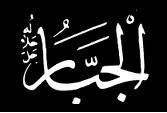
Al-Jabbar- Mending the Broken Heart by Jinan Bastaki
Taken from Imam Suhaib Webb’s blog
 In our journey to gain tranquility of the heart, we explored what we need to know when faced with difficult situations. We need to understand that Allah has told us we will be tested, that these tests are for a reason, and that there will be relief insha’Allah (God willing). When we are worried thinking about the future, we need to work hard but have full trust in Allah that He will not leave us, and we must always think well of Allah because that is what we will find.
Yet in certain circumstances we just feel… broken. Perhaps it is the death of someone close, perhaps a hurtful word, or perhaps a reason we can not pinpoint. Yet this feeling of brokenness can be an invitation to be better acquainted with al-Jabbar.
But isn’t al-Jabbar one of the Names that indicates Majesty and Strength, not Mercy and Beauty?
The root of al-Jabbar is ja-ba-ra and has a wide variety of meanings indicating Allah’s strength and majesty, which Sr. Amatullah explained to us in this excellent article. One of the basic meanings of this name is the One who compels and restores, and demonstrates Allah’s Majesty and Strength over His servants. This is a Name for the tyrants and oppressors to be aware of, because their misdeeds will not go unpunished.
Yet this Name has another dimension: al-Jabbar is the One who is able to restore and mend what is broken. Some of the great scholars would supplicate “Ya Jaabir kul kaseer” when they were faced with overwhelming difficulty, meaning “Oh You who mends everything that is broken.” The Arabic word for a splint that is used to help an arm heal when it is broken is “jibeera” from the same root ja-ba-ra. Thus, when we feel broken, we need to go to the only One who can mend our state–al-Jabbar. Sometimes when we get this broken feeling, shaytan (satan) tells us not to go to Allah because we are being hypocritical by only going to Allah when we are down. Yet this is untrue– Allah has named Himself al-Jabbar and given Himself this attribute; you cannot go to the One whose attribute is mending what is broken, and not be healed by Him.
The example of the Prophet ﷺ is a beautiful one. Imagine being 50 years old, having just lost both your wife of twenty-five years and your uncle who took care of you as a child. Imagine walking into a town in order to ask people for their protection, and instead have them throw stones at you until your feet bleed. How would you have felt? How exhausted, both spiritually and physically, would you have been? And yet, the Prophet ﷺ calls out to Allah in one of the most beautiful and heartfelt du`a’ (supplication):
“O Allah! To you alone I complain my weakness, my scarcity of resources, and the humiliation I have been subjected to by people. O Most Merciful of those who have mercy! You are the Lord of the weak, and You are My Lord too.
To whom have you entrusted me? To a distant person who receives me with hostility? Or to an enemy to whom you have granted authority over my affair?
But as long as You are not angry with me, I do no care, except that Your favor is a more expansive relief to me. I seek refuge in the light of Your Face by which all darkness is dispelled and every affair of this world and the next is set right, lest Your anger or Your displeasure descend upon me.
Yours is the right to reproach until You are pleased. There is no power and no might except by You.”
Read those words carefully. The du`a’ of the Prophet ﷺ was not “O Allah, please give me x and y.” It was literally the call of someone broken– complaining to Allah of his situation and expressing to Allah how he felt. What did Allah give him? A young boy by the name of Addaas saw the Prophet ﷺ, came to him with some grapes and kissed his bleeding feet. That is al-Jabbar. Imagine how the Prophet ﷺ must have felt after that, the relief he must have felt after the cruelty he was subjected to. And al-Jabbar healed the broken heart of the Prophet ﷺ in another way – He bestowed upon him the miraculous journey of al-Israa wal Mi’raaj (when the Prophet ﷺ traveled from Makkah to Jerusalem, and from Jerusalem to the Heavens in one night).
If we think about the journey, it did not accomplish a great victory nor did it help to convince the Quraysh that he was a rophet. Rather, Allah honored him after all the hardship he had gone through. Think of the resolve the Prophet ﷺ must have had in his heart and the tranquility he must have felt after such an experience.
Therefore, we have to always remind ourselves of this blessed name al-Jabbar; Allah will mend your broken heart. It may be through a kind word from someone that brightens your day or it may be a talk that you attend. It may even be something greater. But call on Allah like the Prophet ﷺ did, recognizing this attribute, and know that He will manifest this Name in your life.
Highly recommend reading “How to Achieve Tranquility of the Heart Series” on Imam Suhaib Webb’s blog.

 Healing Hearts

Recent Comments