The Virtues Tour- 2011

Shaykh Ibrahim Osi-Efa (UK), Shaykh Yahya Rhodus (USA) and Shaykh AbdulKarim Yahya (US/Yemen)
16th February 2011- Luton
As-salamu’alaykum!
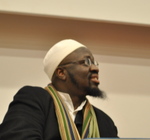
Please be aware that these are my notes; I was unable to write down everything, but what I have, I pray it’s of some benefit to the readers. Any mistakes, errors or misinterpretations of words are from me alone, so please do forgive and overlook my shortcomings! You are welcome to share these notes but *please* do not just copy and paste the notes without referencing where you got them from; I do not want my notes to be taken out of context or misinterpreted. Also, the photos have been provided by Ahqib Hussain, please do not save and re-use them without his permission. Keep him in your prayers!
May Allah reward all those at Fountain Institute who assisted in organising and facilitating this blessed event. May Allah Most Merciful elevate the ranks of our Shayukh, bless and protect their families and teachers. Amin!
——————————————————————————————————————————————————————————–
 Introduction by Shaykh Ibrahim Osi-Efa
– Alhumdulilah, we praise Allah subhananhu wa’tala for the blessing He has bestowed upon us. (Shaykh Ibrahim then quoted the verse from surah Ibrahim) “And if you should count the favor of Allah , you could not enumerate them” [14:34]
– The blessing of Allah subhananhu wa’tala is the Prophet Muhammad sallaAllahu alayhi wasalam, and from that great blessing, every other blessing that Allah subhananhu wa’tala extends towards us comes from him sallaAllahu alayhi wasalam.
– It is imperative for each and every single one of us in this crazy age we live in, for us to become of those who are more acquainted and familiar with the prophet salla’Allahu alayhi wasalam. By that we do not just mean in terms of his great outward disposition and how how he looked in this world. What is more important for us are the attributes of the prophet sallaAllahu alayhi wasalam came to complete his virtues. That is why the prophet sallaAllahu alayhi wasalam said, as quoted in the Muwatta of Imam al Malik, ‘that the only reason I was sent was to complete the noble virtues of character’.
– The prophet sallaAllahu alayhi wasalam praised the book of Allah, the Quran. He brought the sunnah himself. The prophet sallaAllahu alayhi wasalam was the walking Qur’an, like our mother Aisha radiAllahu anha informed us. Hence when we approach the Qur’an, we should approach it in order to see what the reality of the prophet sallaAllahu alayhi wasalam was.
– Those great virtues Allah subhananhu wa’tala bestowed upon the Prophet sallaAllahu alayhi wasalam were the cause of reason why the prophet was named Muhammad, sallaAllahu alayhi wasalam, the one who possesses great and abundance virtues qualities. And for that reason Allah praised the Prophet sallaAllahu alayhi wasalam and refered to him sallaAllahu alayhi wasalam as someone who has tremendous character (surah Rum).
-What do we know about the prophet sallaAllahu alayhi wasalam? As Muslims, as well as non-Muslims, the project begins to understand the most important individual, sallaAllahu alayhi wasalam.
– We hope to share on this blessed night that we should understand that whenever we are in the praise of Allah subhananhu wa’tala it is blessed; whenever we are in the praise and remembrance of the prophet sallaAllahu alayhi wasalam, it is blessed.
– The purpose is to get to know the prophet sallaAllahu alayhi wasalam. Not in an abstract sense just so we can get information about who he is, but in the real sense so we can embrace that which he came to complete, which are attributes that are beloved to the Lord of existence, subhananhu wa’tala.
– We will look at the nature of the virtues of the prophet sallaAllahu alayhi wasalam from the perspective of the human character.
– Wisdom will be the greatest topic because it’s the property of the believer. Likewise, we will look at the great quality of temperance, which comes by desire; the appetite of the human being is placed into a state of moderation and becomes virtuous. And the third topic we will look at is the issue of anger, and how when anger is brought into a state of balance, it becomes a great prophetic quality. All of these will help us give a greater understanding of who the prophet sallaAllahu alayhi wasalam was and about who Allah subhananhu wa’tala wants each and every single one of us to be. We ask Allah subhananhu wa’tala not to treat this gathering as a gathering of entertainment but we treat this as a gathering of sacred engagement. (Amin!)
 Shaykh AbdulKarim Yahya
– Alhumdulilah for the blessing of Muhammad sallaAllahu alayhi wasalam, that one part that encompassed all of Allah subhananhu wa’tala’s creation of mercy. And he sallaAllahu alayhi wasalam was an example for humanity of magnificent character; such that Allah praised him – ‘And indeed, you are of magnificent character’ [68:4]. Allah revealed this verse in the context of reputation of a slander that was made by his sallaAllahu alayhi wasalam enemies who called him a madman. The understanding, which was understood from this is that a madman cannot have a magnificent character because no one has a magnificence character expect those who posses a magnificent ‘aql’- intellect or reason. And that is the capacity as Shaykh Ibrahim mentioned, the quality of the magnificent ‘aql’, which stems the quality of wisdom, and other qualities which also stem like courage and temperance. Allah praised the prophet sallaAllahu alayhi wasalam intellect as magnificent.
-Part of the make up of human character is the faculty of intellect or reason- ‘aql’, and also at times, Imam al Ghazali calls this ‘knowledge’. This capacity (aql), if it is refined by connection to revelation, bears the fruit of hikmah- wisdom. Its refinement is through learning. And if this quality of intellect is refined through revelation then it bears the fruit of wisdom and wisdom is the head of all those other noble characteristics.
– No one reached perfection in these noble characteristics except the prophet sallaAllahu alayhi wasalam. He sallaAllahu alayhi wasalam is the example for anyone who wishes to be characterised by these qualities. To the extent to which we are near to him sallaAllahu alayhi wasalam in these qualities, we are nearer to Allah; and to the extent we are distant to him sallaAllahu alayhi wasalam in these qualities, we are distant from Allah.
– The refining of this capacity of intellect is through knowledge. In our case, it is through learning, and in his sallaAllahu alayhi wasalam’s case, Allah Himself refined him. The prophet sallaAllahu alayhi wasalam would say that ‘My Lord taught me adab and did so well’.
-If we look at many of the Qur’anic verses related to character which were directed to him, all of them were revealed to him initially and through all of these verses, Allah refined him sallaAllahu alayhi wasalam and shaped him and he embodied the Qur’an. His sallaAllahu alayhi wasalam’s character was the Qur’an, and with the Qur’an he taught us sallaAllahu alayhi wasalam.
– Surah Hujarat- ‘The believers are only the ones who have believed in Allah and His Messenger and then doubt not but strive with their properties and their lives in the cause of Allah . It is those who are the truthful’ [49:15]. In this verse Allah subhananhu wa’tala mentions these qualities; the quality of knowledge, and that is the belief in Allah and his Messenger sallaAllahu alayhi wasalam and that which is unshakeable; they believe in Allah and his Messenger sallaAllahu alayhi wasalam and then they have no doubt; knowledge of Allah and yakeen and certainty which is the extent of hikmah-wisdom.
– In the case of hikmah (wisdom), we want to look at the life of the prophet sallaAllahu alayhi wasalam in which it shows his hikmah, his intellect which was refined, and directed and led by revelation, producing in him an excellent management and penetrating insight. Also encompassing things and seeing them through the light of knowledge, and seeing them through inner sight, and dealing all of that in context of his certitude and his certainty in Allah which was the extent of Hikmah. An example of this was the hijra of the prophet sallaAllahu alayhi wasalam. After 13 years in Makkah, a large group of the Ansaar came and gave an oath to defend him sallaAllahu alayhi wasalam as they defended themselves, their wives and children. At that point, he sallaAllahu alayhi wasalam gave permission to his companions to make hijrah. Until this happened he sallaAllahu alayhi wasalam waited, and that was from his excellence management and complete certitude and reliance upon Allah subhananhu wa’tala. He sallaAllahu alayhi wasalam himself waited behind until Allah subhananhu wa’tala commanded him to leave Makkah. When the Quraysh saw that the believers were making hijrah, they conspired to kill the prophet sallaAllahu alayhi wasalam. At that point Gibril alayhi salam descended with revelation and informed the prophet sallaAllahu alayhi wasalam of their plan and instructed him to make hijrah. The prophet sallaAllahu alayhi wasalam took measures. He sallaAllahu alayhi wasalam managed and organised, and used his penetrating intelligence, and told Sayyidina Ali to lay in his bed and gave him his shawl to wrap over him. Again he sallaAllahu alayhi wasalam used his insight and connection to Allah’s book and he left his house reciting the verses of surah Yasin, from the beginning up until the verse where Allah says they see not:
‘And We have put before them a barrier and behind them a barrier and covered them, so they do not see.’[36:9]
He sallaAllahu alayhi wasalam understood from this verse that it essentially blinded them (the Quraysh) from him so they could not see him sallaAllahu alayhi wasalam when he exited. He then sallaAllahu alayhi wasalam went to Sayyiduna Abu Bakr. There were many measures of planning that were taken for the hijrah, for example Abu Bakr prepared two camel mounts that were in excellent condition for the journey. They then departed from Makkah. The prophet sallaAllahu alayhi wasalam, as he was departing Makkah looked at the Kaaba and spoke to Makkah. He sallaAllahu alayhi wasalam said ‘Indeed you are the most beloved of Allah’s lands to Allah and you are the most beloved of Allah’s lands to me and were you people not to have driven me from you, I would not have left.’
They went to the mount Thawr in which there was a cave and they stayed there for 3 nights. During their stay, again they had a well-organised plan. Things were placed in their proper places but their reliance wasn’t on the plan, but on Allah subhananhu wa’tala which is part of hikmah, that is connected to revelation and yakeen- that one plans and organises, but above everything is Allah!
As we all know, Allah willed that a spider created a web over the cave, and 2 wild doves laid their nests outside. Despite all of this, the disbelievers got very close to the cave. They got to the point where they were standing immediately outside of the cave. At this point, the person who’s aql is limited to that which is measurable and is material, and right in front of his 5 senses, they will feel that ‘now my plan has failed’. That’s is! However the person whose heart and insight is ignited and wisdom is connected to revelation, has certitude of Allah subhananhu wa’tala.
In a hadith we hear Sayyidina Abu Bakr say to the prophet sallaAllahu alayhi wasalam that if ‘they (Quraysh) looked at their feet, they will see us’ – the prophet sallaAllahu alayhi wasalam showed his yakeen (certainty) to the extent which is this hikmah, by saying that ‘what do you think of the 2 where Allah is their 3rd? So my plan isn’t because of this cave, or this mountain or the provision we brought, the mount we used etc, my plan is because I am dependant upon Allah and I know that He is with me!’ That was the response of the Messenger of Allah.
And this is a lesson for all of us in our mind and our planning, that we never divorce our relationship from Allah subhananhu wa’tala and that we do not depend or rely upon ourselves and our planning, but we depend and rely upon Allah subhananhu wa’tala.
The deeper wisdom is that the one who truly relies on Allah and is stripped of everything; the one who has knowledge and faith in Allah knows that this is his best state. The poet said- ‘From entrusting ones affairs to Allah, causes super abundance of what one would hope for.’ So this might have been the best state for the prophet sallaAllahu alayhi wasalam because he knows that this is not my plan, this is Allah’s plan and Allah is with us. That was how they were in the cave, in a state of absolute certitude and in a state with Allah and that was the fruit of his intellect, his wisdom that was defined by revelation and instructed directly by Allah. They stayed in the cave for 3 days. After the 3rd day, they hired a Bedouin guy, but it shows again the wisdom and management of the prophet sallaAllahu alayhi wasalam because the Bedouin was non-Muslim and he sallaAllahu alayhi wasalam didn’t know if he would embrace Islam. Regardless, the prophet sallaAllahu alayhi wasalam took the means that were shown to him and hired a non believer to lead him because that person had skills in that area and knew the route well. He took the means but relied on Allah. Then they made their way to Madinah.
-We want to have Madinan hearts; hearts that the full moon rises over them!
-If we want our hearts to be refined, we have to embrace the Messenger. The Ansar sheltered the Messenger. We have to shelter him sallaAllahu alayhi wasalam in our hearts and if we do that, then that will be the cause of noble character.
– This quality of ilm, or aql or wisdom, or reason, is Allah’s Messenger sallaAllahu alayhi wasalam!
-What about you and I? How are we going to refine this faculty of ours so we have hikmah?
– Imam al- Ghazali in the Ihya says that this is refined through learning, however through its proper conditions and etiquettes. We should follow him sallaAllahu alayhi wasalam and look at him as our teacher.
– He sallaAllahu alayhi wasalam was taught by Allah directly. Allah gave him sallaAllahu alayhi wasalam knowledge but he still begged him for more knowledge – ‘Rabbi zidni ilma!’ O my Lord increase me in knowledge.
– Each of us need to be in active pursuit of knowledge. We can’t think about hikmah without knowledge. If we wish to have knowledge, we have to respect and adhere to the conditions which are iklaas, humbleness etc.
-Imam al- Haddad gave 3 counsels to strengthen our Yakeen (certainty) in the Book of Assistance:
1. Listening to His words and the sayings of the prophet sallaAllahu alayhi wasalam where His attributes are mentioned. We have to not only listen to the Book, but to the one upon whom it was revealed to, sallaAllahu alayhi wasalam. There has to be a connection to that initial heart and mind that was refined and illuminated, i.e the prophet sallaAllahu alayhi wasalam.
2. Reflection. Using our 5 senses to reflect on the wonders of Allah’s creation.
3. Striving and acting according to the knowledge we have learnt.
We ask Allah to grant us a connection to the prophet sallaAllahu alayhi wasalam! (Amin!)
 Shaykh Yahya Rhodus
-Alhumdulilah. There are 2 blessings I would like to mention that Allah has given us in order to be here tonight and experience what we are experiencing:
1. Blessing of gathering together of this sort and if the only thing we were to do was to gather together and sit in this room and just look at each other without saying anything, we would benefit immensely from just that. When believers gather there are very powerful and important things that happening; some of them are related to the outward and some are related to the inward. But just the mere gathering of Muslims for the sake of Allah subhananhu wa’tala, and no one here came for any ulterior motive, except for the contentment of Allah is important; especially if we think about the great prophet sallaAllahu alayhi wasalam of ours we are speaking of lived over 1400 year- the fact we are still here in Luton and are mentioning him!
2. The blessing that as Muslims, we still know how to live. That we are some of the only people left on the earth that know how to live. When we are talking about the different stations we are trying to reach as shaykh Ibrahim was mentioning early, about these different states and that in order to be religious people we have to be rational people, and to be rational people we have to be human beings and there is type of maqam, a station in our times to actually be human!
– We live in a time where we see a consumer society; you can sum up modernity as an economic system. From the time we wake up in the morning and go to sleep in the evening, we are susceptible and in this never-ending process of consumerism that is trying to captivate our mind, body and soul. Trying to subjugate that to turn us into a consumer. This whole idea which is being created that your happiness is through consumption! This is a complete lie!
– We believe Allah subhananhu wa’tala can provide for us in ways which are unexpected. Ways that don’t even come to our mind.
– The trait of temperance that we will be speaking about is very important and practical.
– As a believer you should realise you have something to offer to the world; that you can offer a practical example of the synthesis of this great trait in your life. This is the trait of temperance.
-The whole idea of temperance is self-restraint, it’s an idea of abstaining and moderation.
– Temperance as defined by one the scholars is a state that overtakes the heart, that forbids one from having desire overcoming them.
– Imam al Ghazali gives us a hierarchy of desires:
1. Base desire- first desire, which is eating and drinking. This begins when we are very young.
2. Desire for the opposite sex. This comes as we grow a bit older.
3. As one gets older, another desire is to have status, to be renowned.
4. Last desire is for us to want to know everything.
– The whole state of believers ,and to be of balance and exercise self- restraint, we have to understand all of these desires and how they relate to human being. We have to understand we were not created to be consumed. We were created a live uprightly and morally for the sake of Allah subhananhu wa’tala
– If you look at the life of our prophet sallaAllahu alayhi wasalam, you will find the most beautiful examples of someone who lived outwardly in the world but completely abstaining from it in terms of his heart.
– Hadith- where the prophet sallaAllahu alayhi wasalam never once ate bread and meat unless there were other people eating with him. He sallaAllahu alayhi wasalam never ate like that when he was on his own. If he ate lunch he wouldn’t eat dinner and if he ate dinner he would not have had lunch. His poverty was by choice; the only time he indulged was when other people were with him. This life he sallaAllahu alayhi wasalam lived of renunciation, if we believers have this understanding and just cut back, we will see the benefit of it.
– Temperance, when this quality is in a state of balance, it produces good qualities and when imbalance it produces bad qualities.
– When you see any picture of the grave of the prophet sallaAllahu alayhi wasalam, you will see 3 verses written on the top right hand corner. Within that, there is a line of poetry from Imam al-Haddad. It says: ‘The prophet sallaAllahu alayhi wasalam whose character is the character that the All-Merciful has magnified in His book.’ It could have been about him praying or his struggles or knowledge, but what is there is about his character.
– No matter how much knowledge you have, if you do not have a state or know how to interact with people, you will never be accepted or successful.
– Every single person you come into contact with, it is an absolute obligation that you represent your prophet sallaAllahu alayhi wasalam when you interact with them. You have to interact with them in a prophetic manner.
-One of the worst things you can do to someone is force them out of Islam.
– It doesn’t matter what they write about you, but if you interact with every single person in a prophetic way, none of that would matter because they would know regardless of what a Muslim is.
– Temperance is the ability to have self-restraint. It’s the ability to control your desires according to your intellect and the sacred law, which all comes from learning.
-We are an ummah of knowledge. We all have to learn from the cradle to the grave and we have to continue to learn.
– Zuhd- definition Imam al-Ghazali gives is: ‘Its’ for you to divert your desire for something to that which is better than it!’
– Direct your desire towards something that should be worth it. You will never be able to remove desire but instead you direct it elsewhere.
– When you have the ability to restrain yourself and attach your heart to Allah, then this is the way to attain Divine Love and become beloved to Him.
 Shaykh Ibrahim Osi-Efa
– Alhumdulilah. Any topic that we discuss that brings us closer to the prophet sallaAllahu alayhi wasalam is a topic that is worthy of discussion. Especially when that topic will in view inshaAllah in us the attributes that are not only beloved to the prophet sallaAllahu alayhi wasalam but are beloved to the Lord of the prophet Muhammad sallaAllahu alayhi wasalam.
– Hadith- the closest to me on the day of judgement are those in character. As we heard our dear brother and Shaykh Yahya allude to the various stages the human being, the soul of the human being goes through as it engages the physical realm, that there will be attributes that will manifest. The attribute of desire. It’s the first desire, this faculty of appetite. The need and want of man, we see that evident inside the child. The lower self, the nafs is similar to a child. The child is full of desire.
– We see the manifestation of anger in and around the age of 7. Many of us when we were youngsters had a fight in school because we wanted something. When we are pre 7, we are cute, we get everything we want. But when we are no longer cute, we realise we cannot get what we want, we throw tantrums. We get angry.
– The faculty of anger links to the faculty of intellect.
– The 3 faculties: faculty of desire, faculty of anger and faculty of intellectual and rational, these are the 3 essential elements of what we call character human character.
– Once we have developed the faculty of intellect, then we reach or attained that age they call puberty, Allah sends different types of forces. By this point, every single faculty is negative. At this point Allah sends 2 forces upon man; a good force and an evil force. The angelic forces are the good forces and the evil forces are the demonic forces. Both are going to seek to take control of the battlefield, the war begins and the war ultimately is a war that gives problems because the negative forces have already taken control of the battlefield. And usually the one who gets into the battlefield first, wins. And that is why we are fighting an uphill struggle.
– Our topic is the topic of anger. Topic of anger is important because by virtue of master over the faculty of anger, we thereby master all of what the virtues the prophet sallaAllahu alayhi wasalam came to complete.
– That is why when one of the sahaba (companions) came to the prophet sallaAllahu alayhi wasalam for advice, he said ‘do not get angry’. He kept repeating the question and the prophet sallaAllahu alayhi wasalam kept replying ‘do not get angry.’
– Imam al-Ghazali said that it is impossible for us to not become angry because anger is inbuilt into us. It’s a created inward reality and we cannot get rid of a part of you. What the prophet sallaAllahu alayhi wasalam was saying was CONTROL your anger.
– The sahaba were from an environment of intense anger, intense rage and jahiliiya, age of ignorance and wanton recklessness. Wanton violence, where anger is out of control.
– Arabs were not cowards. They were very angry people. Arabs were extremely violent people, therefore for us it is important to understand what the prophet sallaAllahu alayhi wasalam did and what he achieved?
– He tamed those who were believed to be untameable. He brought to a middle point those who where believed to be reckless, impossible to bring them to a middle point.
– The mission of the prophet sallaAllahu alayhi wasalam was to tame the intense rage and anger that Allah crafted the Arabs upon!
– Arabs still know how to get angry, just like we saw recently in Egypt and Tunisia.
– When the prophet sallaAllahu alayhi wasalam asked the sahaba about who is the strong and powerful one? The sahaba replied that the one who is skilled in the art of wresting, in fighting etc. He sallaAllahu alayhi wasalam said no, the one who is able to control his rage and anger and when his rage and anger is provoked is strong and powerful. That is why Allah not only praises the one who can suppresses rage, but the one who can suppresses rage, forgive and forget those who or what provoked the rage inside them.
– Allah does not give us abstract words, He wants to take us higher so each and every single one of us sees paradise! It’s a difficult task.
– Sayyinduna Umar was the personification of anger. He was a very angry man. He said that in the days of jahiliyya before he became Muslim, his anger was for his nafs, to gain the things he desires. But when he became Muslim, he became angry for Allah! That is the taming of the faculty of anger!
– Allah subhananhu wa’tala sends us a being who taught us practically how to suppress rage, his name was Muhammad sallaAllahu alayhi wasalam!
– We should ponder that; we should reflect on that. If we were to switch off the lights and sit and reflect, everyone would disappear. We don’t know how to go to the deeper meanings. How do we in relation to Muhammad sallaAllahu alayhi wasalam who came to perfect every single attribute for you, we should personalise the YOU.
– Allah’s pleasure will not be granted to someone who’s anger in out of control.
– When the sahaba asked the prophet sallaAllahu alayhi wasalam what is the most feared reality, he sallaAllahu alayhi wasalam replied that its ‘the anger of Allah!’. They asked, ‘Ya RasullaAllah how do we not occur the anger of Allah?’ He replied, ‘you control your anger. If you control your anger, He will control His anger towards you’.
– As you treat others, Allah subhananhu wa’tala will likewise treat you.
– And that is why we see in the prophet sallaAllahu alayhi wasalam himself was someone who came to teach us how to suppress rage. Because when we suppress rage and anger and we bring it to this median point between two extremities of excess and deficiencies, it brings forward a beautiful quality called courage.
– Why did Sayyidina Ali ibn Talib say the prophet sallaAllahu alayhi wasalam was the most courageous of people? It’s because the prophet sallaAllahu alayhi wasalam defined the reality of courage.
– People go into excess. We have on the one hand, people of extreme anger. Then we have the opposite extreme of cowards- we are people of laxity of anger, laxity of intellect, laxity of desire.
– But the prophet sallaAllahu alayhi wasalam came with balance, came with moderation and we are an ummah of moderation.
– The prophet was tested. The reality of bravery manifests when one is tested. One of us can claim we are brave but when we have to stand on a battlefield, we can be tested.
– Bravery can be tested. When we see the atrocities over the world, the blood of man is being spilt that manifest the negative qualities….
– We either have too much anger or we have those who are cowards!
– The intellect has to take control over anger. The intellect plays an important role in putting the anger in check.
– The prophet salla’Allahu ‘alayhi wasalam was somebody who in each and every moment was in tribulation. How would you feel if you were born without a father? How would you feel if you were given to a stranger when just 2 weeks old and then taken to the dessert? Children become traumatic when placed in the hands of those they are not familiar or their natural parents- it’s a trauma for a child, how would you feel? Allah subhananhu wa’tala sent blessed beings to ensure the child (the prophet sallaAllahu alayhi wasalam) is not traumatic but something that is nurturing. but what was it that was nurturing him? In the dessert, in those early years, he was given the great blessed attribute which relates to anger, it controls anger. Its called Hilm, that is why he is Ibn Halima!
– The nature of hilm is the ability to control your anger and respond to the one who provokes anger in you by doing that which is beautiful. Somebody who does wrong to you and you only respond by doing good to them- that is prophecy. This was recognised by anyone who interacted with the prophet sallaAllahu alayhi wasalam.
– The prophet sallaAllahu alayhi wasalam met Sayyidina Abu bakr wondering the streets of Madinah and asked him what has brought you here in the middle of the night. He says I left my house just to see the face of the Messenger of Allah. I left my house in the middle of the night – Abu bakr couldn’t sleep! Abu bakr yearns for the prophet sallaAllahu alayhi wasalam in the middle of the night, not just crying and yearning in the house, but a yearning that forces him out of the house in the middle of the night just to see the Messenger of the Allah sallaAllahu alayhi wasalam. He found him and gazed upon the face of the prophet sallaAllahu alayhi wasalam. “I’m yearning for the prophet” he used to say to his blessed wife.
– He came with the ability to control rage and anger. We see the difficulties of his sallaAllahu alayhi wasalam‘s life in each and every single moment but he responds to them in beautiful way.
– Clemency is the ability not to just forgive; not just to forgive and forget; but it is to forgive, forget and to act beautifully to the one who does you wrong.
– One of the beautiful names of Allah- He is al-Ghafir- the Forgiver, and al-Ghaffur, the one who forgives in abundance. Allah is also al-Haleem the One who when people do Him wrong, He only does them right. That is Allah!
———————————————————————————————————————————————————————————–
Jaza ‘Llahu anna Sayyidina Muhammadan sallaAllahu alayhi wasalam ma huwa ahluhu
Jaza ‘Llahu anna Sayyidina Muhammadan sallaAllahu alayhi wasalam ma huwa ahluhu
Jaza ‘Llahu anna Sayyidina Muhammadan sallaAllahu alayhi wasalam ma huwa ahluhu
Subhana Rabbika Rabbi l’izzati amma yasifun, wa salamun ala l’mursalin, wal-humdulillahi Rabbi l’alamin.












 Healing Hearts



Recent Comments