
You are currently browsing the yearly archive for 2009.
I’ve recently been introduced to Nur al-Din ‘Abd al-Rahman ibn Ahmad al-Jami, more often known as “Jami”, who was one of the greatest Persian and Sufi poets in the 15th century. I haven’t read much of his writings just yet, but having read the following, I think his poetry is something I might quite enjoy!
“Hidden behind the veil of mystery, Beauty is eternally free from the slightest stain of imperfection. From the atoms of the world, He created a multitude of mirrors; into each one of them He cast the image of His Face; to the awakened eye, anything that appears beautiful is only a reflection of that Face.
Now that you have seen the reflection, hurry to its Source; in that primordial Light the reflection vanishes completely. Do not linger far from that primal Source; when the reflection fades, you will be lost in darkness. The reflection is as transient as the smile of a rose; if you want permanence, turn towards the Source; if you want fidelity, look to the Mine of faithfulness. Why tear your soul apart over something here one moment and gone the next? “
~ Jami, translation by Andrew Harvey and Eryk Hanut – ‘Perfume of the Desert’
“Oh my heart,
Don’t become discouraged so easily.
Have faith.
In the hidden world, there are many mysteries,
many wonders.
Even if the whole planet threatens your life,
don’t let go of the Beloved’s robe
for even a breath.”
~ Rumi
Sayyidah Rabi’a al-‘Adawiyyah (may Allah be pleased with her and elevate her rank) was an incredible figure in Islamic spirituality. Her love for the Divine and poetry is truly captivating. Thought I’d share some of her amazing poetry here, as she is a great inspiration for many of us no doubt.
” O God the stars are shining;
All eyes have closed in sleep;
The kings have locked their doors,
Each lover is alone, in secret, with the one he loves,
And I am here too; alone, hidden from all of them – With You”
“The true knower looks for a heart that comes from God alone.
As soon as it is given to him, he gives it back again
So that God can hold it hidden in His Mystery,
Safe from the tampering of human hands”
“Your hope in my heart is the rarest treasure
Your Name on my tongue is the sweetest word
My choicest hours
Are the hours I spend with You —
O Allah, I can’t live in this world
Without remembering You–
How can I endure the next world
Without seeing Your face?
I am a stranger in Your country
And lonely among Your worshippers:
This is the substance of my complaint.”
“In love, nothing exists between heart and heart.
Speech is born out of longing,
True description from the real taste.
The one who tastes, knows;
the one who explains, lies.
How can you describe the true form of Something
In whose presence you are blotted out?
And in whose being you still exist?
And who lives as a sign for your journey?”
“Let me hide in You
From everything that distracts me from You,
From everything that comes in my way
When I want to run to You.”
Subhan’Allah, may we aspire to be like Sayyida Rabi’a and follow in her footsteps by increasing our devotion and love for the Divine!
I was going through my journal (I basically keep a book where I jot down any gems, words of wisdom, profound quotes/stories etc I pick up from influential writers, scholars, poets etc) and came across some points I had noted whilst listening to one of Shaykh Husain Abdul Sattar (may Allah preserve him) lectures a few years ago. I thought I’d share the points here as it’s something which I’ve been currently reflecting on.
“Understanding Sabr”
The noble Shaykh begins the talk quoting the following verse from the Qur’an al-Karim:
In Allaha ma’a al-sabireen (Verily Allah is with those who have sabr).
The Shaykh talks about the people of Sabr (patience). He mentions that there are three types of patience that a person who believes in Allah ta’ala exhibits; and when they exhibit all three types of patience, irrespective of the situation that they face, that is when the truest meaning of the verse (In Allaha ma’a al-sabireen ) comes within their lives.
Types of patience:
1. Sabr on the good deeds that we do. If we are doing good deeds for the sake of Allah ta’ala, we need to be patient on the deed itself, and be regular in how we do it. We find this in the Sunnah of the Prophet sallaAllahu ‘alayhi wasalam; if he sallaAllahu ‘alayhi wasalam prayed a particular prayer, he would continue with that and not give it up. The Shaykh advised that we must be careful in what we add to our schedule; once we add it, we need to be consistent and keep up with it until we meet our Lord ta’ala.
2. Once we have implemented a certain deed and have added it to our schedule, we continue and wait patiently for its effect. For example, if we decide to do tasbi after Fajir, we must be patient with the results of it.
3. We must have Sabr when Allah ta’ala bestows a difficult situation on us, and that we are content with it. We shouldn’t complain, instead realise that the difficulties that undergo in this world are to purify us. We cannot worship all the time or stay away from so much sin; however if we remain patient, Allah ta’ala draws us closer to Him!
Overall, we must remember that whatever we are going through is from Allah ta’ala. Permanent difficulty is distance from Allah ta’ala, and that is what we have to complain about! Thank Allah ta’ala for the difficulties, and know that Allah ta’ala is with the people who have Sabr!
The above is just food for thought and reflection for myself (first and foremost.), and may it benefit all those who read this blog entry, inshaAllah ta’ala. Please note that these are just some of the points which I made whilst listening to the lecture, therefore please do not take them as direct quotes from the Shaykh- I’ve paraphrased! I would strongly recommend listening to the actual lecture which can be found here.
A beautiful thought shared by our beloved teacher Imam Zaid Shakir on the Rihla in 2006:
“Within us all there lies the potential to realize our dream. However, within only a few of us there lies the courage to realize our potential”
~ Imam Zaid Shakir
(8th July, 2006, Madinah)
A few of my favourite quotes by the great Shaykh (May Allah elevate his rank and be well pleased with him)
“Whoever is truthful in something and pursues it diligently will obtain it sooner or later; if he does not obtain it in this world, he will obtain it in the next; and whoever dies before victory shall be elevated to the level of his diligence.”
“If you find it complicated to answer someone’s question, do not answer it, for his container is already full and does not have room for the answer”
“The ignorant one does not see his ignorance as he basks in its darkness; nor does the knowledgeable one see his own knowledge, for he basks in its light”
“The word “shams” (sun) is feminine, and “qamar” (moon) is masculine. The sun burns itself out to give light and life to everything around, and the moon is muneer, meaning it reflects the light. Within itself it has no light; it radiates the brilliance of the sun. So when we shine as men, the implication is that we are reflecting the glorious light of our women…” ~ Shaykh Abdullah Adhami
Everyone on the right path is sincere, but not everyone who is sincere is on the right path. ~Shaykh Afifi al-Akiti (may Allah preserve him)
Have you ever taken part in an activity called “Trust Fall”?
Basically, “Trust Fall” is a trust-building activity performed as a group in which a person deliberately allows himself to fall, relying on the other members of the group to catch him. This type of activity is very popular in team building away sessions where the emphasise is on building a trusting relationship with your colleagues.
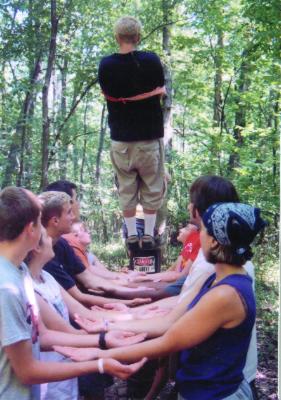
It’s amazing how during those type of exercises, we can just easily relax and fall back! We have the complete confidence that the individual/group will catch us. We trust them.
When the trials of life overwhelm us and we find ourselves perturbed, worried, distressed etc, we should apply the same principle and have conviction that no matter what happens, Allah will not let us fall! He subhanahu wa’tala will catch us.
So relax, fall back and let Him catch you. Just like Mawluna Rumi says in one of his poems “Fall into the Safety of God”.
A story is told about a King in Africa who had a close friend that he grew up with. The friend had a habit of looking at every situation that ever occurred in his life (positive or negative) by remarking, “This is good, Allah Almighty knows best”
One day the King and his friend were out on a hunting expedition. The friend would load and prepare the guns for the King. The friend had apparently done something wrong in preparing one of the guns, for after taking the gun from his friend, the King fired it and his thumb was blown off.
Examining the situation the friend remarked as usual, “This is good! Allah Almighty knows best.”
To which the King replied, “No, this is NOT good!” and ordered his soldiers to put his friend into jail.
About a year later, the King was hunting in an area that he should have known to stay clear of. Cannibals captured the King and took him to their village. They tied his hands, stacked some wood, set up a stake and bound him to the stake.
As they came near to set fire to the wood, they noticed that the King was missing a thumb. Being superstitious, they never ate anyone who was less than whole. So after untying the King, they chased him out of the village.
When the King reached his Palace, he was reminded of the event that had taken his thumb and felt remorse for his treatment of his friend. He went immediately to the jail to speak with his friend.
“You were right” the King said, “It was good that my thumb was blown off.” And he proceeded to tell the friend all that had just happened. “I am very sorry for sending you to jail for so long. It was bad for me to do this.”
“No,” his friend replied, “this is good…Allah Almighty knows best“
“What do you mean, ‘this is good’! How could it be good that I sent my friend to jail for a year?”
The King’s friend replied: “Remember that the Almighty knows best and if I had NOT been in jail, I would have been with you on that hunting trip.”
“He knows what is before them and what is behind them: And to Allah go back all questions (for decision)”
Qur’an: Surah Al Hajj 22:76
Do Not Judge Things or Events by its Immediate Outcome!
Although the decisions of Allah Ta’alah may seem harsh to us, they are full of wisdom
Source:Qisas

 Healing Hearts
Recent Comments